
Council 'justified' in refusing 18-home development outside Larne, says commissioner
Appeals lodged with the Planning Appeals Commission for a proposed housing development outside Larne have been dismissed.
The appeals by Carnlough Development Ltd for 18 proposed new dwellings were in relation to lands 50 metres east of 4 Blackcave Crescent and 40 metres north of 222 The Woods and 30m north of 110 The Woods and 20m east of 27 The Woods, Larne.
An application for outline planning permission was turned down by Mid and East Antrim Borough Council in April 2024.
Commissioner Kevin Gillespie’s report said: “The main issues in both appeals are whether the appeal developments are acceptable in principle in the countryside; have an adverse impact on the Antrim Coast and Glens Area of Outstanding Natural Beauty (AONB); would result in the loss of open space; would result in urban sprawl and fail to integrate; would create or add to a pollution problem; whether surface water flooding can be effectively managed.”
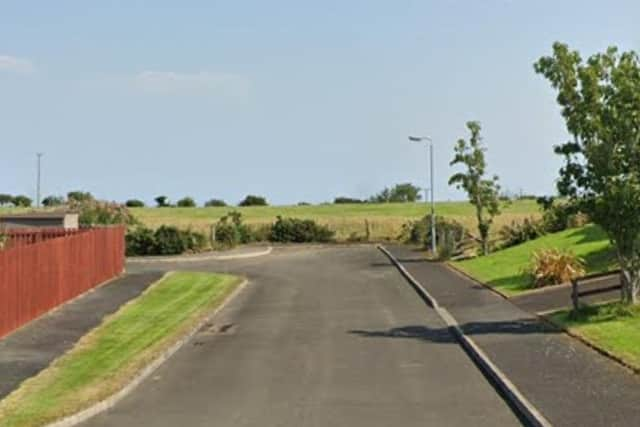

Mr Gillespie’s report continued: “On the ground, both appeal sites comprise irregular shaped areas of agricultural land, measuring some 1.48 hectares (site one) and 1.16 hectares (site two) in area. Both appeal proposals seek outline planning permission for the erection of nine dwellings.
“The council and third parties assert that both appeal proposals lie in the countryside outside the settlement development limit of Larne and that, if allowed, they would mar the distinction between the urban area and the surrounding countryside, result in urban sprawl and a suburban style build-up of development and would not be integrated into the surrounding landscape.
“However, the appellant considers that both appeal sites form part of the urban area of Larne and that the council is therefore incorrect to apply policies relating to development in the countryside to both proposals given that both appeal sites form part of the urban area of Larne.”
Physical Boundaries
The commissioner said: “I am also satisfied that the physical boundaries on the ground form a coherent boundary and settlement edge to distinguish the urban area of Larne from the countryside. I have concluded that the appeal sites are within the countryside.
“In his evidence, the appellant states that the current dwellings were not intended to form the edge of the settlement limit and were strategically left by the appellant in readiness for further development and were intended to enable the rounding-off of The Woods development.
“As I have not been provided with any overriding reasons by the appellant why both appeal proposals are essential in the countryside and could not be located within a settlement, both appeal proposals are contrary to policy.”
The commissioner went on to say the council’s first reason for refusal and the related concerns of the third parties is therefore “sustained”.
“I have already concluded that both appeal sites lie in the countryside adjacent to but outside the development limit of Larne town. Whilst access is proposed via the existing roads within the adjacent residential development, the appeal proposals would still represent a sizeable extension to Larne town,” the commissioner added.
“The size, scale and location of the proposed developments would not complement or read as part of the existing urban fabric.”
It was noted one of the sites would be “visually prominent due to the sharp rise in topography beyond The Woods and Cairnbeg Crescent to the north”.
The commissioner also said: “I am also not persuaded that the appeal proposals would represent rounding off The Woods development.”
The report indicated the appeal proposals would “mar the distinction between Larne town and the surrounding countryside and result in urban sprawl and a suburban style build-up of development”.
“Both appeal sites lie within the Antrim Coast and Glens AONB. In both cases, the council contends that the introduction of nine dwellings and associated development onto this important headland would not be compatible with the landscape and distinctive character of the AONB and would be visually obtrusive and prominent in this sensitive landscape.”
However, it was noted the appellant disagrees and the appeal proposals, both “individually and cumulatively, would integrate into the landscape such that the integrity of the landscape and distinctive character of the AONB is retained”.
The commissioner concluded from the viewpoint at Old Glenarm Road, near Hillmount, the “cumulative effect of the appeal proposals would be visually prominent in the landscape”.
Michelle Weir, Local Democracy Reporter