
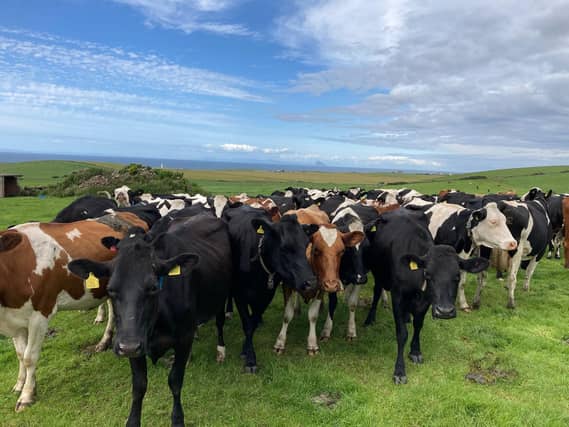

On July 1, 15 farmers headed off to Drumbreddan Farm near Stranraer for the first farm visit on their study tour. Father and son, Lamont and Daniel Hair run a 1,320-acre dairy and beef farm which consists of approx. 900 stock, with all dairy cows cross bred with Augus, Limousin, Hereford and the odd British Blue.
For almost 20 years, the Hair family has worked on what they call their 20/10 ‘system’ where three times during the year the bulls will be with the cows over a fifty-day period. This provides calving periods of February/March, June/July and October/November which supports cash flow, better use of bulls, easier management of calf groups and better all year-round use of the finishing sheds.
Up next the group visited Johnny and Gillian Wilson on Knockneen Farm, a short distance from the village of Kirkcolm. It lies in a scenic and fertile farming region known as the North Rhins Peninsular. This area of Southwest Scotland is renowned for its production of quality livestock and early grass growing potential. After making the move to Scotland 8 years ago, Fermanagh born Johnny is now on his fourth milking season on this 490-acre farm.
The 280 cows are calved in two six-week calving periods – one in autumn, one in spring and are bred using a three-way cross, aiming to produce a robust grazing cow with high milk solids. Johnny focuses on a more traditional grazing system where the cows spend days at grass, in turn reducing labour inputs along with the need and costs of handling, storage and spreading manure.
The group then headed onwards to Dumfries to enjoy a lovely meal together whilst discussing their Scottish adventure thus far. It was another early start for the group the next morning as they visited 2 farms within the Dumfries area, before making their journey back to the boat.
The group's first visit was to Andrew and Aileen Marchant tenanted farm on the outskirts of Penpoint village. Having started with a mere 12 ewes in 2012, the farm now consists of a herd of 65 pure Luing and Aberdeen Angus cross Luing cows, a flock of 850 ewes, 200 Aberdeen Angus cross dairy stores and a deer herd.
Andrew has continually expanded his business, gaining extra rented land nearby allowing him to build stock numbers further. His farming system is relatively extensive and low input with cows outwintered and ewes lambing outside. The cow and sheep genetics are improving from buying in performance recorded tups and ewes and more recently, using wool shedding tups.
The last visit on their farming tour was to Kilnford Farm Shop. The group were warmly welcomed by Jock Rome, owner and founder of Kilnford Farm Shop who gave them an extensive overview of his farming background and the history of the farm shop.
Jock’s family have been farming on the land around Kilnford in Southern Scotland for over 300 years. Kilnford Farm Shop was established in 2011 and brings the very best of their home reared Galloway beef, black faced lamb and outdoor reared pork, as well as local produce to the community within Dumfries and Galloway.
Melissa Wylie, Farm Support and Therapeutical Services Programme Manager at Rural Support said “Our farm study tour had a transformative impact on our farmers by providing hands-on exposure to agricultural practices, challenges, and innovations.
"It offered a unique opportunity to learn directly from experienced farmers, observe diverse farming systems, and understand the day-to-day realities of farm life. It has been fantastic to see the Royal Countryside Fund Farm Resilience programme flourish within Northern Ireland and from this our farmers have gained more confidence, built professional networks, and ignited a deeper passion for farming, laying a strong foundation for a stronger, more resilient farming enterprise.”
Rural Support have been responsible for facilitating the Royal Countryside Fund Farm Resilience Programme in Northern Ireland for almost a decade. The programme consists of six formal meetings, hosted by various consultants, to include Promar, Saviour Associates, Burnhead Rural Services, Farm Safety Foundation and The Andersons Centre. Each of the workshops help the farm families, manage their business more efficiently and improve resilience while identifying opportunities to benefit the family farm.
If you would like more information on this programme or other services within Rural Support, please call their freephone confidential Support Line on 0800 138 1678, available Monday to Friday from 9am to 9pm. Alternatively, visit their website at www.ruralsupport.org.uk and click ‘Get Help’ at the top right-hand side of the page.
5. Contributed
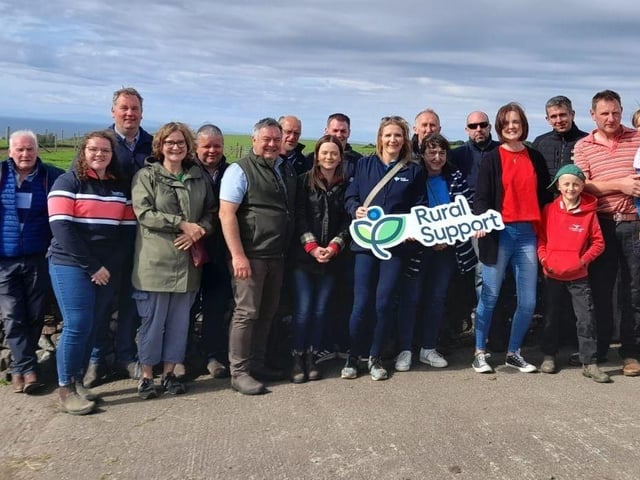
NI Farmers visiting J&G Wilson Farm in Scotland Photo: Submitted