
South Eastern Trust patient helps to break new ground in coeliac research
A South Eastern Trust gastroenterology patient is helping to break new ground in coeliac disease research after becoming the first patient in the United Kingdom to take part in a groundbreaking international clinical trial at the Ulster Hospital.
The Ulster Hospital is the first Clinical Research Centre in the United Kingdom to recruit a patient to the early phase clinical trial, which is researching an investigational medicine for coeliac disease.
The international study will involve approximately 60 participants worldwide and is the first time this investigational medicine has been studied in people with coeliac disease.
Caroline Clarke, who was diagnosed with coeliac disease in 2019 after years of unexplained symptoms, has volunteered to take part in the ANB033-101 clinical trial being led by the Gastroenterology and Research Team at the South Eastern Trust.
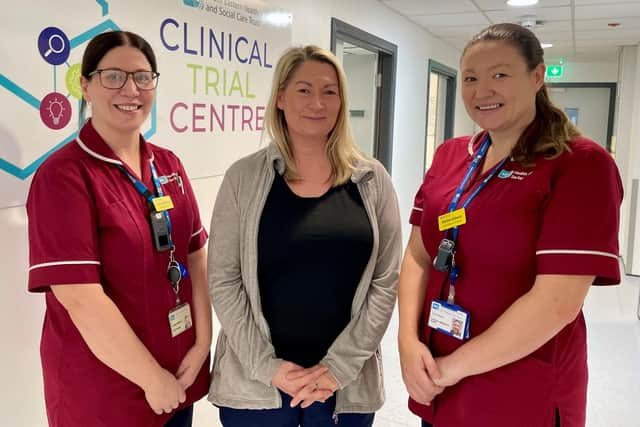

Caroline explained: “I have always had stomach issues throughout my whole life.
"It took quite a few years before doctors started to investigate coeliac disease because it was not really known and it was not necessarily the first thing they would test for.
“I was diagnosed in 2019 and started my gluten-free diet then, I have definitely felt an improvement.
"The gluten-free diet is very hard. When I heard that clinical trials were coming up, I thought that was amazing because there is no drug or medication currently available for coeliac disease.
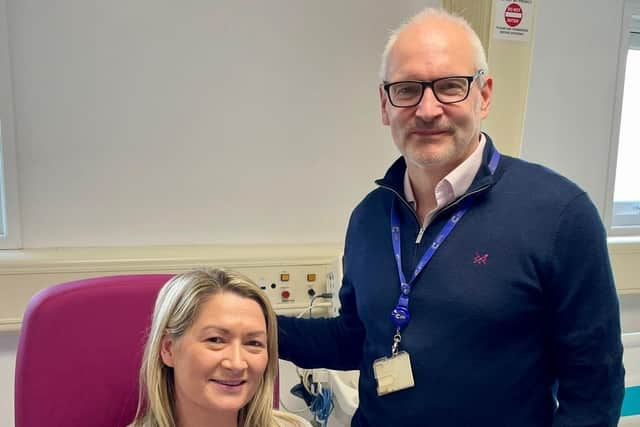
"I thought it would be very rewarding to be part of the trial and help the coeliac community.”
South Eastern Trust, Consultant Gastroenterologist, Dr Grant Caddy is leading the Trust's involvement in the research.
Dr Caddy explained: “Coeliac disease is a very common condition. It has a prevalence of around one in 100 people in the community and many people may not know that they have it.
“Patients can have a whole range of symptoms. Some can be completely asymptomatic while others can experience diarrhoea, weight loss, abdominal bloating and a range of other gastrointestinal symptoms.
“We look after a large number of patients with coeliac disease across the South Eastern Trust and currently the only treatment is a strict gluten-free diet. Despite following a gluten-free diet, a significant proportion of patients continue to experience symptoms."
The ANB033-101 study is researching whether the investigational medicine can potentially improve the intestinal damage associated with coeliac disease.
Dr Caddy added: “This is a groundbreaking drug trial and we are hoping to establish whether this investigational medicine can benefit patients with coeliac disease and particularly those who continue to experience symptoms despite following a gluten-free diet.
“The South Eastern Trust is the first centre in the UK to take part in this trial and to recruit a patient. It is a multi-centre international study and we are very excited to be involved and to contribute to research into coeliac disease.”
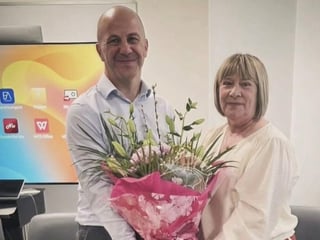
Dr Caddy added: “Obviously this is an early-stage trial and it may take time before any potential treatment becomes available to patients. But this is an important stepping stone in the direction of trying to improve care for people living with coeliac disease.
“We are delighted to have Caroline as our first participant and grateful to her and all our patients who take part in research.
"Their contribution is vital in helping us develop our understanding of disease and explore new treatments for the future.”