
The day a white shirt made Molyneaux see red!
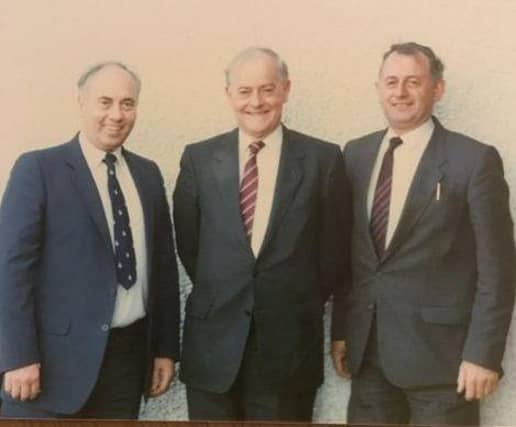

I am one of a select band of Unionists with whom former Ulster Unionist leader, Jim Molyneaux, known as ‘Gentleman Jim’, lost his temper.
The first time I met Jim Molyneaux was in 1970 and I was a Primary Six student at Clough Primary School.
Jim had been victorious in the Westminster General Election of that year, comfortably winning the South Antrim seat with a majority of almost 40,000.
Jim later visited the Presbyterian Manse after the North Antrim disaster in which the UUP lost a safe seat to a certain Rev Ian Paisley. Jim tried to boost morale in the constituency. He already knew dad through their work in the Loyal Orders and I always found him to be the perfect gentleman, hence his moniker in the party Gentleman Jim.
From that first visit to the Manse in 1970, Jim became a regular visitor to our home over the years until he gave up the leadership in 1995. He was a great conversationalist, especially at the dinner table when the main political business had been discussed.
While he had served in the British Army during the Second World War, there was one topic which was off limits - the Nazi death camp at Bergen-Belsen in Germany which Jim had helped to liberate in April 1945. This year marks the 80th anniversary of that liberation.
Jim would certainly chat openly about his experience in the Army and even incidents during World War Two, but rarely about what he had witnessed in Bergen-Belsen.
Politically, after 1979, he would talk privately about his special relationship with Tory Prime Minister Margaret Thatcher. But her signing of the November 1985 Anglo-Irish Agreement with Dublin hit Jim hard as he clearly had been caught totally unawares of Thatcher’s decision.
Jim regarded my dad as a political confidante. They enjoyed a special camaraderie through the Loyal Orders, the party and the Right-wing UUP pressure group, the Ulster Monday Club.
During the 1980s, dad had served a three-year term as Assistant Sovereign Grand Master of the Royal Black Institution when Jim was Sovereign Grand Master.
During this time, too, other young unionists who were also members of the Ulster Monday Club had staged a coup within the North Antrim Young Unionist Association and swung politically what had previously been in the late 1970s a liberal youth movement into a radical Right-wing movement.
Stereotype
But in spite of the high media profile which the North Antrim Young Unionists enjoyed, the perception of us was that we were merely upper middle class, pin-stripe suited, grammar school educated Tory ‘toffs’. How on earth - given this stereotype - were we meant to make our movement attractive to the loyalist working class in the constituency and beyond?
The impact of the initial Ulster Says No campaign was to mobilise a lot of previously nominal Unionists and loyalists. A series of radical organisations began to appear and recruit; this was certainly a time of intense mobilisation among the pro-Union community as a backlash to the Anglo-Irish Agreement.
Organisations such as the Ulster Clubs (meant to be a modern day mirror image of the Unionist Clubs which had been formed in the early 1900s to opposed Home Rule in Ireland), the pro-independence Ulster Movement for Self Determination, the Ulster Resistance (with its distinctive red berets) began to emerge.
Even the UDA was erecting recruitment posters. On the political front, the DUP had launched its own youth wing, the Young Democrats, and specifically in North Antrim, the Progressive Unionist Party (the party closet to the thinking of the UVF and Red Hand Commando) was recruiting young people. Even the Far Right National Front was recruiting young loyalists at that time.
There was the real danger that with all these organisations targeting the loyalist working class, we ‘toffs’ in the Young Unionists would fall behind in terms of influence.
While many people can recall the ‘never’ chant from Paisley senior’s City Hall speech at the Ulster Says No rally at Belfast City Hall, no one could seriously remember a key quote from Jim’s speech that day.
And so he called at my parents’ home to discuss Ulster Unionist tactics. As Young Unionists, we had decided to take the initiative when it came to recruiting among the loyalist working class and had launched via the media our ‘Loyalist Youth Unite and Fight’ campaign.
Over a meal, I had the chance to unveil to Jim what our strategy would be to attract more working class loyalists into the Young Unionists, especially from the large marching band fraternity in the constituency.
Emphasising that I wanted to build a street movement made up of young loyalists who could then be indoctrinated into the Young Unionists, I dropped the bombshell which blew up in my face.
In line with the Ulster Says No parades, this would be the marching face of the Young Unionists in loyalist areas. Drawing on my days in the Boys’ Brigade when we wore white shirts as part of dress code on parade, and in the Presbyterian children’s choir when the boys wore white shirts and the girls white dresses, all our Young Unionists on parades would be ‘The White Shirts’.
Jim blew a fuse when I used the term ‘White Shirts’ and it was only then that I truly understood the horrors of what he had witnessed in Bergen-Belsen. To say that Jim was furious with my idea is an understatement.
He loudly informed me that under no circumstances was I to launch any such movement known as the ‘White Shirts’; we would recruit young loyalists into the Young Unionists in the usual manner.
Ridiculous
There was an awkward silence at the dinner table in my parents’ home. I had now earned the distinction of being one of the few people in Unionism with whom Jim had ditched his ‘Gentleman Jim’ persona and had actually lost his temper.
Turning to dad, he said he wanted a word with him to ensure that I did not pursue this ridiculous notion of recruiting from the loyalist working class under the banner of ‘White Shirts’.
It was only after Jim left for home in Crumlin that dad explained what a disastrous notion I had unveiled to the party leader. For Jim, talk of a ‘White Shirt’ movement conjured up images of Mosley’s Black Shirt movement (The British Union of Fascists), Ernst Rohm’s Nazi Brown Shirt movement (the SA), and General Eoin O’Duffy’s Blue Shirt movement in Southern Ireland (the forerunners of the modern day Fine Gael party).
For Jim, it was not about giving the White Shirt movement a unique Young Unionist working class identity, but in copying the image of ‘shirted’ movements which had in their own ways contributed to the Holocaust which cost six million people their lives in the most horrific manners.
The notion of ‘Coulter’s White Shirts’ was never mentioned again. While he personally never discussed what he had witnessed at Bergen-Belsen with me in detail, I knew by his furious anger at my proposal that it must have been a truly horrific experience.
While the White Shirts recruitment proposal was binned, we did lose ground to other organisations in County Antrim and by the late 1980s the North Antrim Young Unionists was a movement without any real influence.
Then again, if we had stuck to our guns, defied ‘Gentleman Jim’ and launched the White Shirts as a marching movement among the loyalist working class, could we have prevented young Protestants from getting caught up in paramilitary or criminal activity?
Dr John Coulter has been a journalist since 1978.