
Baha’is of Magherafelt raise concerns about persecution of members in Iran
The Baha’is of Magherafelt have raised concerns about ten Bahá’í women in Isfahan who were sentenced to a combined 90 years in prison for organising 'educational and cultural activities' in October.
Independent UN experts also issued a late 2024 joint statement denouncing ongoing home raids, travel bans, and prolonged sentences imposed on Bahá’í women, describing these actions as a continuous pattern of targeted discrimination.
A new resolution has just been adopted by the United Nations General Assembly’s Third Committee and highlights what it describes as “a continued increase in and the cumulative impacts of long-standing persecution” against a wide range of recognized and unrecognized religious minorities in Iran, naming “in particular, Bahá’ís,” as well as Christians, Gonabadi Dervishes, Jews, Sufi and Sunni Muslims, Yarsanis and Zoroastrians.
Parallel reporting by human rights organisations—including the Abdorrahman Boroumand Center and Human Rights Watch—has documented the breadth of violations against the Bahá’í community by Iranian government, from executions and imprisonment to economic, cultural, and educational exclusion. Human Rights Watch characterised the 45‑year campaign against Bahá’ís as amounting to the crime against humanity of persecution.

The resolution concludes with a call for Iran to honour its obligations under international law, including ensuring the right to “freedom of thought, conscience and religion or belief” for all its citizens. It underscores that the situation facing Bahá’ís and other minorities is not isolated but part of a broader pattern of repression affecting the entire society.
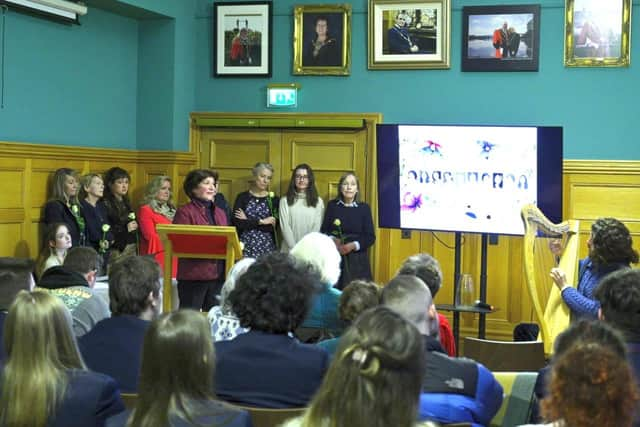
Meanwhile, the Baha’is of Magherafelt continue to mark the passing of ten women who were hanged in Iran four decades ago for their belief in the equality of men and women, and the necessity of freedom of expression and the unity of all the peoples of the world.
A spokesperson said: "That is a struggle that is still going on, not only in that country but here in NI and around the world. The Baha’is are working alongside like minded organisations who are invited to contact them at: [email protected]
"The Our Story Is One campaign is resonating with the deepest aspirations of populations around the world to turn to unity rather than division and to see the interconnectedness of our stories.
"It seems an appropriate time to remember the sacrifices made by people who cry ‘Peace’ and pay the ultimate price. It is important to make known to those who seek to erase the names of the peacemakers that they shall not be forgotten.
"Rather those names become an inspiration to achieve ever greater levels of personal action to secure freedom, unity and justice in our communities, especially in the field of women’s equality which was not only at the heart of their sacrifice, but is at the heart of many other problems in the world from mental and physical health, to the education of the next generation and the protection of the environment.
"We need to teach our children the meaning of peace and remind ourselves just how fragile it can be and how precious it is.!
The ten Baha’is women of Sharaz executed on June 18, 1983, are Mona Mahmoudnejad, aged 17; Roya Eshraghi, (23); Simin Saberi (24); Shahin (Shirin) Dalvand (25); Akhtar Saber (25); Mahshid Niroumand (28); Zarrin Maghimi-Abyanch (29); Talereh Arjomandi Siyavashi (30); Nosrat Ghufrani Yaldaie (46); Ezzat-Janami Eshraghi (57).
More background information available at www.ourstoryisone.bic.org