
Northern Ireland has a 'once-in-a generation opportunity to create an integrated green skills system that works effectively for individuals, business and the economy
The priority of decarbonising the economy presents a huge once-in-a-generation economic opportunity, attendees at the Northern Ireland Green Skills conference have heard.
The conference brought together key stakeholders for a day of thought-provoking discussions and expert insight.
Held in the Europa Hotel, Belfast, the conference was organised by National World Events, part of the same company as Northern Ireland World.
In the keynote address, Department for the Economy Permanent Secretary Ian Snowden shared what the Department is doing about green skills and how they will help deliver a more competitive and sustainable economy that works for everyone.


"Everyone here will know about the goal of achieving net zero carbon by 2050. This goal has become law in Northern Ireland when the Assembly passed the climate Change Act in 2022,” he said.
"Since the Executive returned at the start of last year, decarbonising the economy has been one of the Minister for the Economy’s four priorities, along with more good jobs, addressing regional imbalance and increasing productivity.
"The decarbonisation priority is in part a response to the legal and moral imperative of taking action to address climate change.
"But there is also a huge economic opportunity in decarbonisation; if we can properly grasp that opportunity it will be nothing short of transformative for the health and prosperity of our society.
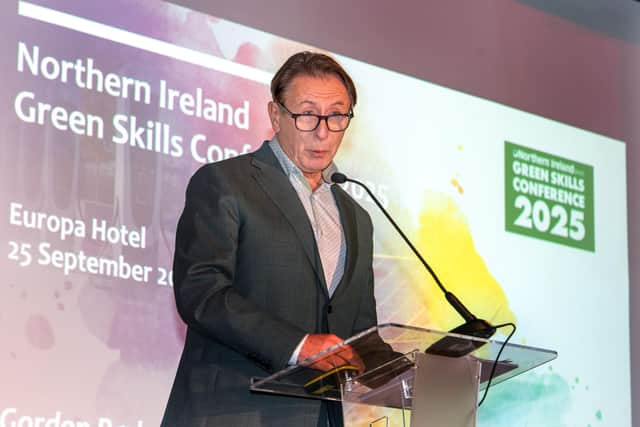
"This opportunity is not just once-in-a-generation – it is probably unique. It is very difficult to imagine that we are ever going to have to make such a radical whole system change to the way we generate, store, distribute, buy or deal with energy ever again, and the economic change that will flow from that will be enormous.”
Mr Snowden said decarbonisation will fundamentally restructure the economy, as businesses and industries change how they operate to reduce their emissions and seek out new markets for low carbon products.
"A lot of the time, this is about better, lower carbon versions of existing products and systems and we have an idea about what we need to do and how to go about it. Replacing fossil fuel heating systems with heat pumps is an obvious example of this.
"We also have to be ready to respond to opportunities that will come with new technologies, products and innovations that are only just starting to be thought of. If we are able to grab those opportunities, we can be at the forefront of whole new industries that will develop in the next few decades. Even better, if our people are coming up with those new technologies here, we can be world leaders.
"All of that will only be possible if we have the skills that we need, here in Northern Ireland. We have to build a workforce that is prepared, flexible and highly skilled.
"We will need to develop green skills in almost every industry and sector of our economy. From renewable energy to low-carbon construction and circular economy practices, these skills will fuel the transformation that we need.”
To see the flip book from the Northern Ireland Green Skills conference, click here.
Mr Snowden said the Green Skills Action Plan, published earlier this year by the Department working with the Green Skills Delivery Group, is a framework that will guide Government, employers, educators and citizens on what is needed to deliver the skills and green jobs of the future.
"As you would expect, it places a lot of emphasis on education and training. But it also looks at how to make the sector attractive and inclusive and how we can set up strong partnerships that will deliver the skills our people need to build careers in the green sector.
"The Action Plan will create accessible routes into green careers through apprenticeships, reskilling programmes, and targeted support for those moving in to low-carbon sectors.
"It will put industry at the forefront of green skills development, to ensure our people have the right knowledge and expertise to work in the jobs of the future and ensure sustainable growth across all the economy. It will involve employers in helping us to shape skills delivery as well as sharing knowledge, best practice and resources to maximise our collective impact.
"By working together, we can improve our skills eco-system and deliver the workforce that employers need to succeed in a more sustainable future.
"The Green Skills Delivery Group will play an active role in the implementation of this plan. It will establish stakeholder partnerships and a hub that will help people get access to expert information and advice. It will ensure that green skills are integrated into all levels of education, and it will work across government to embed green skills into the work of our new Local Economic Partnerships and the City and Growth Deals.
"The Green Skills Action Plan will also support new energy policies the Minister is bringing forward in 2025. These include publication of the final scheme design for new renewable electricity support, which will incentivise more renewable electricity generation and position the region as a competitive and attractive destination for investment. Later this year the Smart Meters Design Programme will be launched, and the Department will publish a scheme design for future low carbon heat and energy efficiency support in residential buildings.
"These policies are part of delivering the Executive’s Energy Strategy – Path to Net Zero Energy, which will move us away from our reliance on fossil fuels, and the exposure to volatile prices that comes with that, towards self-sufficiency in affordable renewable energy that will ensure our homes and businesses to pay a fair price for the energy they consume.
"I have already said that the decarbonisation of energy represents possibly the greatest economic opportunity ever afforded to this island. The Green Skills Action Plan is evidence of the work the department, in partnership with businesses, employers and academia, is doing to ensure that we are ready to seize that economic opportunity and deliver the Minister’s four economic priorities of decarbonisation, more good jobs, improved productivity, and better regional balance.
"I want to emphasise that whether you are a business leader, educator, trade union representative or working in the community and voluntary sector ,you all have a role to play. By working together, we can deliver the transition to net zero and realise the opportunities that it presents for a more prosperous and inclusive economy.”
Gordon Parkes from NIE Networks, Chair of the Green Skills Delivery Group, delivered a presentation to the conference about the Group’s Action Plan.
He explained how it identifies 28 actions across four priority areas – the skills eco system, a partnership approach to ensure a skills system that is responsive to changing needs, promoting awareness of careers and opportunities in the green jobs and green skills and developing a skilled workforce.
Mr Parkes explained it as presenting “a once in a generation opportunity to create an integrated green skills system that works effectively for individuals, business and the economy.”
Part of his presentation also included a breakdown on what is meant by “green jobs” – defined by the UK’s Green Jobs Taskforce as ‘employment in an activity that directly contributes to – or indirectly supports – the achievement of the UK’s New Zero emissions target and other environmental goals’.
"The Green Skills sector has a hugely exciting future but we need the best skilled talent and enthusiastic re-skilled experts to ensure the sector and the wider economy in Northern Ireland reaches its full potential. It is important that all employers within the sector, government and the education sector collaborate effectively and take ownership of developing the talent pipelines.
"It’s the right thing to do for our people, our families, our communities and for the planet,” Mr Parkes said.