
Refurbishment plans for Limavady bank submitted to Causeway Coast and Glens Council


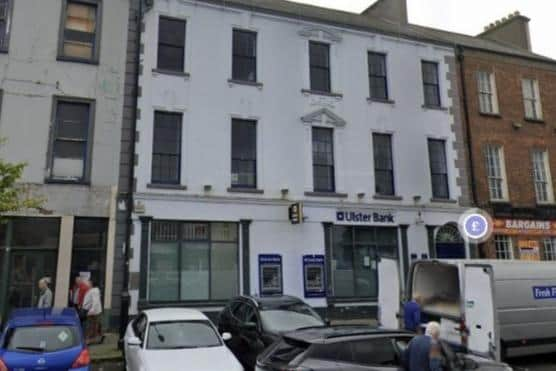
Causeway Coast and Glens Borough Council have received refurbishment plans for the Ulster Bank in Limavady.
The recently-submitted planning application seeks permission for internal alterations to the non-original counters, a new mini consult greeting point, replacement furniture and internal finishes at the listed building at 30-32 Catherine Street.
Additional external works include alterations of a rear window to form a doorway, a new disabled access ramp, dedicated disabled car parking spaces and signage.
In an accompanying Design and Access Statement, agents Tate Stevenson Architects said the work had been requested by Ulster Bank as part of their mission to “reduce the number of counters, introduce automation where possible, improve customer and staff experience, improve access and general refresh of the Ulster Bank internal branding”.
The statement added: “The intention of the design was to be sensitive and respectful to the character of the surroundings.”
“The vision for the design is to provide a high-quality scheme that is sensitive to the site location, to retain the fabric and the appearance of the subject building with minimal alterations, and to create a development that does not have any adverse effects on adjacent properties.
“The building was constructed between 1900 and 1919, listed in October 1977, and occupies a visually prominent location on Catherine Street.
“Catherine Street is a main thoroughfare in the town centre and is a wide access route heavily used by both pedestrians and vehicles, and the immediate setting contains a mixture of both traditional Victorian buildings and modern commercial architecture."