
Refusal of HMO for use by some Ballymena United FC players overturned on appeal
A refusal by Mid and East Antrim Borough Council to grant planning permission for a HMO (House in Multiple Occupation) at 49 Waveney Road, Ballymena, has been overturned by the Planning Appeals Commission.
The proposal for change of use from a four-bed dwelling to a five-bed/five person HMO was turned down by the council’s Planning Committee in January.
There were 40 objections to the proposal expressing concern over increase in density, loss of character, parking provision and HMO licensing. There were two letters of support from Ballymena United Football Club which indicated the facility would be used by some players during the playing season.
A report by Planning Appeals Commissioner Gareth McCallion said the main issues relate to “whether the proposed development would result in the intensification of parking requirements, significantly inconvenience the movement of road users and impact on the local environmental quality of the area”.
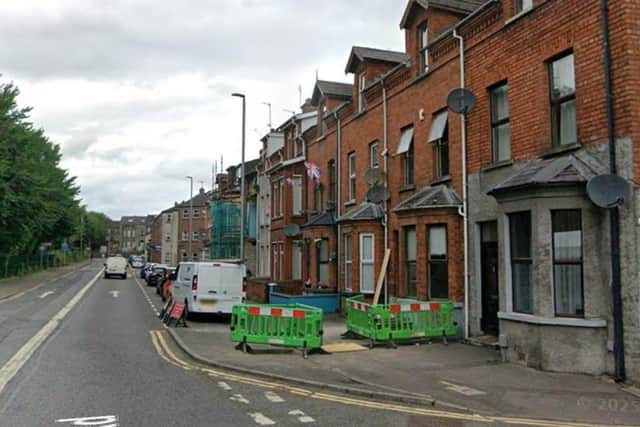

The appeal relates to a three-storey, single-fronted red-brick terraced property containing four bedrooms.
The report said planning policy supports the conversion or change of use of existing buildings to flats or apartments within settlements, provided the proposal delivers a “high-quality residential environment, safeguards the amenity of existing and future occupants, respects the character and appearance of the building and surrounding area, and provides satisfactory access and parking arrangements”.
It noted development proposals must provide “adequate parking and appropriate servicing arrangements and must not not prejudice road safety”.
Parking Standards
It also indicated “flexibility in parking standards may be permitted where sustainable travel opportunities, shared parking arrangements, nearby parking availability or wider planning benefits can be demonstrated”.
“The council argues that the absence of any off-street parking provision results in an over-reliance on on-street parking in an area already identified by DfI Roads as experiencing parking constraints,” the report said.
“It maintains that the proposal fails to provide adequate parking to serve the development and would intensify existing parking pressures.”
“While the council refers generally to concerns that can arise from property conversions, including overlooking, increased traffic congestion and the loss of family-sized housing, it has not identified any specific harm that would arise in this case,” the commissioner added.
Mr McCallion also considered other objections that the proposal would “reduce the supply of family housing, alter the character of the area and undermine community cohesion.”.
“I acknowledge that the proposal would result in the loss of a four-bedroom dwelling. However, the property would remain in residential use and continue to contribute to the housing stock in an alternative form.
“No persuasive evidence has been presented to demonstrate that the loss of a single dwelling would materially affect the supply of family housing within either the established residential area or Ballymena generally, nor that it would undermine the area’s character or function,” he stated.
“The council’s concerns centre on parking and servicing arrangements. I acknowledge that the proposal would not provide dedicated off-street parking and would therefore fall below the indicative parking standards referred to by the council,” the commissioner continued.
However, he stated parking standards are “not absolute requirements and must be considered in the context of the particular development and its location”.
He questioned what he described as a “speculative shortfall identified” by the council, saying that it has not demonstrated that the proposal would “give rise to unacceptable congestion, displacement parking, servicing difficulties or road safety concerns” and “no evidence was provided to demonstrate the quantity of available on-street parking in this area or surrounding streets”.
However, the commissioner said he would “attach significant weight to the absence of any objection from DfI (Roads) and to the parking survey evidence submitted at appeal”.
“This provides objective, location specific evidence of available parking capacity and directly addresses the concern that insufficient information had been provided regarding on-street parking availability,” the commissioner stated.
“There is limited evidential basis for concluding that the proposal would give rise to unacceptable parking impacts,” he stressed.
“I am not persuaded that the proposal would result in unacceptable traffic generation, congestion, servicing difficulties or harm to road safety. I therefore conclude that the proposal satisfies the parking and servicing requirements.
“I have considered the objectors’ concerns that the increase from four to five bedrooms could place additional pressure on local services and infrastructure,” he continued.
“NI Water’s response does not amount to an objection in principle to the proposal. The dwelling is capable of accommodating the proposed level of occupation. No compelling evidence has been provided to demonstrate that the proposal would place an unacceptable burden on existing infrastructure.”
“I also attach little weight to concerns relating to anti-social behaviour, noise, nuisance and the conduct of future occupants. Planning decisions must be based on the likely land-use consequences of a proposal rather than assumptions regarding the behaviour of future residents,” he emphasised.
“My site inspection confirmed that the dwelling contains well-proportioned rooms and retains communal kitchen, dining and living facilities for the benefit of future occupants. In these circumstances, I have no persuasive evidence that the proposed use would result in unacceptable living conditions,” the commissioner also said.
“Interests were also raised that approval of the proposal would set a precedent for further HMO development in the area. However, each planning application must be determined on its own merits having regard to the particular facts of the case and the relevant planning policy framework,” the commissioner explained.
“I find no substantive evidence that the proposal would harm residential amenity, adversely affect local character, create an unacceptable parking or road safety issue, or place undue pressure on local infrastructure.
“Many of the concerns raised by objectors are speculative in nature and unsupported by objective evidence. I conclude that neither the council’s reason for refusal nor the third-party objections have been sustained.”
Michelle Weir, Local Democracy Reporter