
Solar eclipse in Northern Ireland: When to see it and how to experience it safely
Northern Ireland skywatchers are keenly anticipating the experience of an eerie partial solar eclipse.
It is expected that people will be able to witness the wonder in the early evening of Wednesday, August 12 when around 94 per cent of the sun will be covered by the moon.
While the eclipse will be total elsewhere – mainly in Spain – people here will be particularly keen to witness the phenomenon as experts say it will be the largest solar eclipse visible from Ireland until September 2090.
Director of Armagh Observatory and Planetarium, Professor Michael Burton said this partial eclipse is one of the most eagerly awaited for decades.

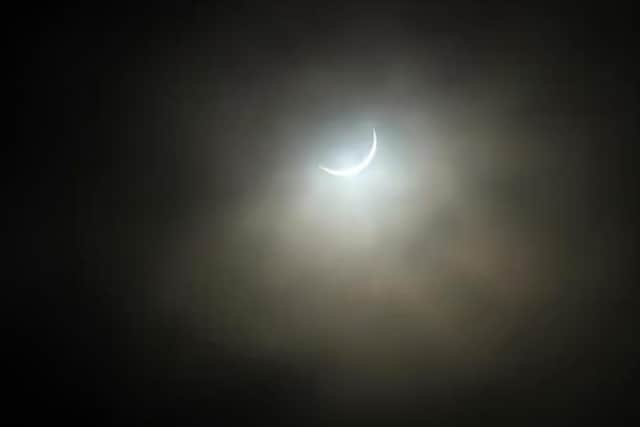
"While we won’t encounter totality here – only a narrow path across Greenland, Iceland and northern Spain will be fortunate enough to encounter this – a 94 per cent partial eclipse is an extraordinary sight in its own right,” he said.
"At its peak, the sun will be reduced to the thinnest sliver of light, low over the western horizon. It is going to be a beautiful and quite eerie spectacle.”
The eclipse will begin at approximately 6.10pm, reaching its maximum at around 7.08pm and concluding shortly after 8pm.
Because the event unfolds as the sun sinks towards the horizon, observers can expect a striking scene, with the crescent sun glowing low in the evening sky.
It follows the partial eclipse of March 2025, which saw around 40 per cent of the sun obscured.
"The last time skies over Ireland darkened to this extent was in 1999. On that occasion people travelled from all over to stand under the path of totality in Cornwall,” Prof Burton added.
To mark the occasion, Armagh Observatory and Planetarium host a day full of family-friendly activities from 10am to 8pm, including hands-on science demonstrations, dome shows and eclipse-themed events for all ages.
"We want this to be a day the whole family remembers,” added Prof Burton.
"Visitors will be able to learn about the science of eclipses, discover how astronomers safely observe the Sun, and enjoy a programme of activities suitable for all ages before joining us outside as the real thing unfolds.”
The Irish Astronomical Association (IAA), meanwhile, is partnering with the Astrophysics Research Centre at Queen’s University Belfast to provide a public observing and outreach event in front of the main Lanyon building on University Road.
Special solar telescopes and other observing equipment will be available and everyone attending will be provided with a pair of special safe eclipse-viewing glasses.
"We will be setting up from about 5.45 pm and staying until the sun is no longer visible from that location – which should be well after mid-eclipse – around 7.30 pm,” Terry Moseley of the IAA said.
"Obviously this event is weather dependent – if it’s totally cloudy, it won’t go ahead.”
How to witness the eclipse safely
If you are preparing to witness the solar eclipse you must do so safely. Looking directly at the sun - even when it appears dimmed - can cause serious eye damage or even blindness.
The IAA said: "You should NEVER look directly at the sun, even during a large partial eclipse, because the part of the sun that is still visible is just as bright as the rest, and it will damage your retina if you look at it. You have no pain receptors in your retina, so you won’t even realise that the damage is being done.
"It is even more important not to look at the sun through any sort of optical aid – eg: telescope, finder, binoculars, spotting scope, camera viewfinder etc. The extra concentrated light will do even more damage, even more quickly. With binoculars, you’ll blind both eyes simultaneously.
"It’s only during totality, if you’re lucky enough to be there, that you can look directly at the sun."
---
Read more:
---
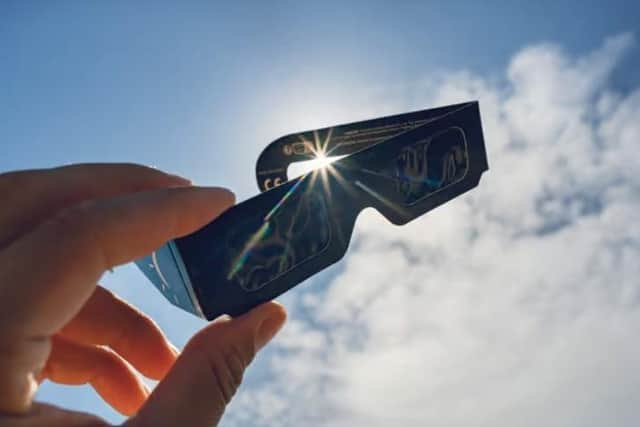
If you have proper CE certified eclipse viewers or glasses, undamaged and from a reputable source, you can use them totally safely. If there are any holes or scratches, don’t use them.
People can also watch safely by projecting an image of the sun onto a white card using a telescope, a cereal box pinhole viewer, or even a kitchen colander.
Astronomers have also advised not to try to take photos directly of the sun using a smartphone as it will almost certainly burn out the sensor. Instead they say you could try photographing it through eclipse viewers or glasses, and you can photograph the projected image on card or in a cereal-box viewer quite safely.