
'Dysfunction' at Stormont as civil service boss Jayne Brady moves press chief without informing First Ministers
Relationships at the top of government have been labelled “dysfunctional” after the Head of the Civil Service moved Stormont’s top press officer into another role without first consulting the first and deputy first ministers.
Jayne Brady removed Chris McNabb – who has led Stormont’s communications for over a decade – as the head of the Executive Information Service (EIS) after what has been described by Stormont sources as a personality clash.

The News Letter understands that the Head of the Civil Service (HOCS) did not consult Michelle O’Neill or Emma Little-Pengelly about the move, and the pair then sought Mr McNabb’s reinstatement. However, by that stage, he had decided to accept her offer of a new post within the civil service (NICS).
Mr McNabb is widely respected across the political spectrum in the Assembly, as well as by journalists. There are concerns within the civil service that there is no plan to replace his expertise in leading the Executive’s communications.
Stormont sources say the relationship between the pair had deteriorated after disagreements over a number of issues which he felt brought into question the impartiality of the NICS.
Neither Mr McNabb nor Ms Brady had commented on questions posed to them by the News Letter. A spokesperson for NICS said: “We do not comment on internal staffing matters.”
UUP MLA Doug Beattie told the News Letter that the situation pointed to “dysfunctional” relationships at the top of government.
“What is of genuine concern is that the head of Stormont's press operations - Chris McNabb - could be removed from post without the knowledge of the First and deputy First Minister.
“That goes to the heart of who actually wields power within the structures of our devolved government. Civil servants answer to elected representatives but in this case it seems that by-passing those elected to the First and Deputy First Ministers office the civil service pull the strings.
“It will be interesting to see what other operational or strategic decisions have been made by the civil service without political oversight”, he said.
Concerns within elements of the NICS about Jayne Brady acting beyond her remit – or at least showing questionable judgement about how her actions could be perceived – began soon after her appointment, when no ministers were in place.
She oversaw the 'Our Giant Ambition' policy document during the Stormont hiatus – which saw NICS setting out a ‘People, Planet, Prosperity’ agenda. Despite Northern Ireland not having a functioning government amid a dispute over the Irish Sea border, the document decreed that the country was “united in vision, mission and focus”.
It further claimed that Northern Ireland is “uniquely positioned for dual market access into GB and Europe” – despite the dispute over those arrangements being at the heart of the political row which led to the collapse of the institutions. Unionists dispute those alleged benefits, given the severe restrictions on trade from Great Britain into Northern Ireland, particularly for the manufacturing sector.
At the time, civil servants were coming under increased scrutiny about how Northern Ireland was being run – despite having no constitutional authority to legislate or formulate new policies. There was little political opposition to the approach taken by HOCS amid the political vacuum.
Eyebrows were raised again in January 2024 when in the midst of negotiations to restore the institutions, in which a funding settlement for public sector pay was a key issue, HOCS appeared at the gates of Parliament Buildings to show support for striking workers.
Northern Ireland’s largest public sector union NIPSA said she “came to show her support”. NICS didn’t dispute that view, saying her attendance was consistent with her stance on public sector pay.
Senior civil servants would later be involved in negotiations with unions after the institutions were restored.
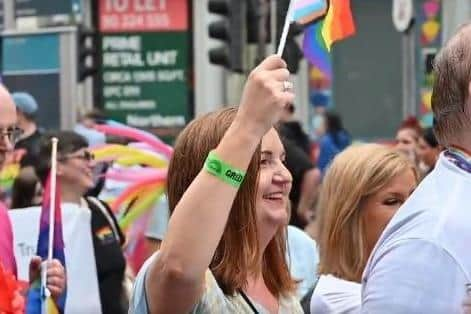
She has also not shied away from other controversial issues - marching in Belfast Pride 2024 waving a 'Progress' Pride Flag, a symbol that is deeply controversial within elements of her own workforce.
However, some within the Stormont system claim that she was not given a fair wind by elements of NICS because she was an outsider. She had previously been the Digital Innovation Commissioner at Belfast City Council, before being appointed to lead the civil service by Arlene Foster and Michelle O’Neill.
The News Letter asked HOCS if:
- she believed that her actions in removing Mr McNabb as head of the EIS without consulting the First Minister and deputy First Minister showed poor judgement, given that his expertise were relied on by both ministers and the office over a long period
- she accepts that NICS is there to provide a service for ministers, and that her actions have undermined that
- she denies that there was a clash of personalities between herself and Mr McNabb, based on advice he had given with which she did not agree about the role of HOCS and the wider civil service
- she denies that some of her actions could be regarded as bordering on political - or at least showing poor judgement about how they could be perceived - particularly during the period when no ministers were in place.
A spokesperson for NICS said: “We do not comment on internal staffing matters.”