
Irish general election: Fianna Fail emerge victorious as Sinn Fein frozen out of power in Dublin
Michael Martin’s party is the clear winner of the Irish general election – with a nine seat lead over rivals Fine Gael and Sinn Fein with all seats counted.
It means the Fianna Fail leader and Fine Gael’s Simon Harris are set to return to government in Dublin. The two parties are merely two votes shy of an overall majority – killing prospect of a left-leaning coalition led by Sinn Fein.
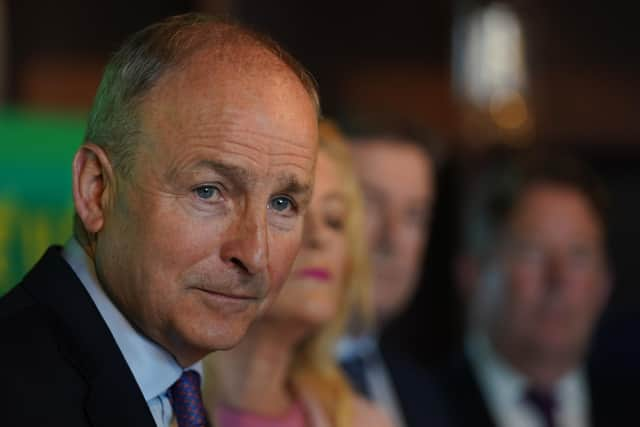

With the last of the Irish parliament’s 174 seats allocated last night after three days of vote counting, Fianna Fail is the clear winner of Friday’s general election, emerging with 48 seats. Sinn Fein had 39 seats, one ahead of Fine Gael on 38.
The result is particularly bad for Sinn Fein. Its 39 TDs is up two from the 37 last time round, in 2020, but is not a real terms increase because the Irish parliament has expanded from 160 to 174 seats, and so it is in fact a slightly smaller share of Dail members than before.
The republican party’s vote share also dropped 5.5% – leaving Sinn Fein with little comfort in an election where the governing parties bucked global trends and comfortably retained power, and SF failed to capitalise on five difficult years for the government.
Undeterred, Mary Lou McDonald contacted the leaders of the Labour Party and the Social Democrats in what the party has portrayed as an attempt to form an alternative government.
Fianna Fail have made clear repeatedly that they would not enter government with Mary Lou McDonald – and they would have no reason to contemplate that given Fine Gael’s performance.
The two parties will either need to secure the support of newly elected independents to take them from their total of 86 seats to the 88 needed for majority in the Dail, or persuade the centre-left Social Democrats or Irish Labour Party to come onboard.
Given the near electoral wipe-out which befell their previous partner the Green Party – who only returned one member of parliament – the smaller parties will be cautious about entering a government where smaller partners don’t fare well in the subsequent election.
After the 2020 general election, it took five months for the previous government of Fianna Fail, Fine Gael and the Greens to strike a deal. But then they were eight seats short of the number of TDs needed, this time they are only two shy.
Sinn Fein TD Eoin Ó Broin has admitted that “the numbers are there for Fianna Fail and Fine Gael to form a government together. This would be the worst possible outcome for the people of the country”.
He said: “Today we have made contact with the leaders of the Social Democrats and Labour Party and we will be contacting the other progressive TDs and groupings this week.
“Our new increased parliamentary team will meet on Wednesday in Leinster House with Mary Lou McDonald and we will assess where we take things at that stage.”
Fianna Fail’s deputy leader Jack Chambers has said no deal will be concluded before Christmas.
However, there is a view across the political spectrum that negotiations must be concluded before Donald Trump’s inauguration on January 20.
There is concern in Ireland that its narrow tax base – hugely reliant on three US companies – will be affected by the Republican president’s new economic policies.
Mr Chambers, the current Irish finance minister, said the parties involved in talks about forming a new administration needed “time and space” to ensure that any new government will be “coherent and stable”.
“I don’t expect a government to be formed in mid-December, when the Dail is due to meet on the 18th of December, probably a Ceann Comhairle (speaker) can be elected, and there’ll have to be time and space taken to make sure we can form a coherent, stable government,” he told RTE.
“I don’t think it should take five months like it did the last time – Covid obviously complicated that. But I think all political parties need to take the time to see what’s possible and try and form a stable government for the Irish people.”
On the Fine Gael side, minister of state Peter Burke said members of his parliamentary party would have to meet to consider their options before giving leader and Taoiseach Simon Harris a mandate to negotiate a new programme for government with Fianna Fail.
“It’s important that we have a strong, stable, viable government, whatever form that may be, to ensure that we can meet the challenges of our society, meet the challenges in terms of the economic changes that are potentially going to happen,” he told RTE.
It appears that Fianna Fail and Fine Gael will once again rotate the role of prime minister – but given the significant lead Micheal Martin’s party has in terms of seats, he will be seeking extra ministries.
The party may also seek to keep certain key roles – like finance – for the duration of the next Dail.