
Supreme Court ruling: Alliance wants courts to clarify a local equality law - after it is produced
The Alliance Party says that the Supreme Court ruling on the definition of a woman highlights the need for local equality legislation – which can be clarified by the courts after it is produced.
The comments by the party’s chief whip Paula Bradshaw are the first by a senior figure in response to the landmark ruling, which happened almost a fortnight ago.
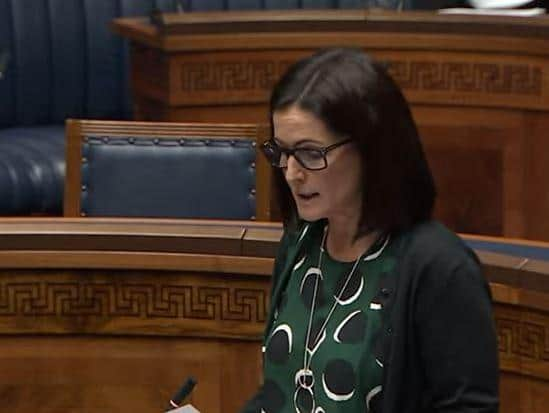

The South Belfast MLA – who chairs the Stormont committee looking at ‘gaps’ in equality legislation – didn’t say whether or not she supported the ruling, but said it was “quite clear”.
Addressing MLAs on Monday, Ms Bradshaw described it as “an extremely sensitive issue” and said politicians need to be “thinking about the non-discrimination of all nine protected categories in Great Britain including sex and gender reassignment”.
She highlighted “complaints” about guidance issued by the Equality and Human Rights Commission (EHRC). The interim guidance was aimed at helping employers and other organisations deal with the ruling in practice.
That guidance – criticised by trans activists – said that under the Equality Act in GB, a woman is a biological woman or girl (a person born female – and a man is a biological man or boy (a person born male). The EHRC’s remit does not extend to NI, where the Equality Commission is the statutory body charged with upholding equality law.
Ms Bradshaw said: “Although the ruling itself – it was quite clear – the legal ramifications in Northern Ireland, given our particular circumstances, are quite complex.
“We are already seeing public authorities making assumptions about how the ruling is to be applied, but it is essential that this is based on appropriate guidance from the appropriate commissions”.
The South Belfast MLA said it reinforces the need for a single equality act here, as current legislation is outdated. “I trust this ruling, whatever our own views on it may well be, has at least demonstrated the merit of a single equality act here in Northern Ireland, and of the potential for courts to clarify about such legislation once it is produced. We cannot continue to be left behind in this regard”, she said.