
UK government must provide answers on who is paying for UK protection of Irish seas - Foster
Ireland must acknowledge that its key undersea infrastructure is being protected by British armed forces – and the UK government needs to come clean about whether Dublin is paying, Baroness Arlene Foster has said.
The former first minister of Northern Ireland says that many in the Republic are “in denial” about the threat posed by Vladimir Putin’s Russia to vital cables linking the country with North America.
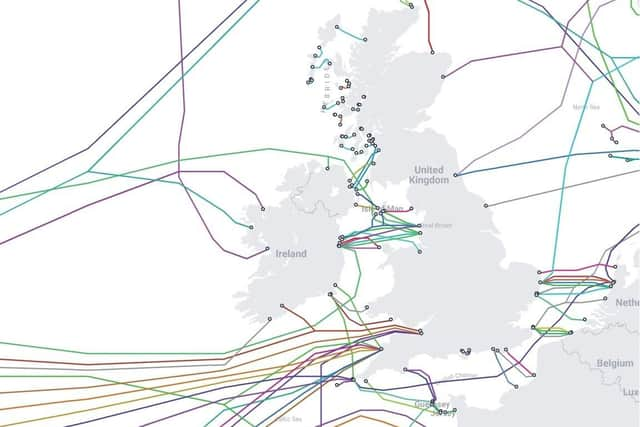

According to a recent report, three-quarters of undersea communication cables in the Northern Hemisphere pass near or through Irish waters, and Russia is taking an increasing interest in them given their key role in the Western economy.
Last weekend, the News Letter revealed our understanding that no money will be forthcoming from Dublin for defence and security commitments made by the United Kingdom as part of a bilateral deal last month.
However, Labour ministers dodged questions from unionist politicians in Westminster this week on whether the Republic of Ireland has paid the UK any cash as a result of the deal.
Baroness Foster and TUV MP Jim Allister both questioned Labour ministers on the updated Memorandum of Understanding on bilateral defence cooperation this week.
Ministry of Defence (MoD) minister Alistair Cairns said any diplomatic deals with other countries “usually involve bilateral benefits”, while his House of Lords colleague Lord Coaker said the deal with Dublin “focused on enhancing maritime cooperation, cyber defence, air domain information sharing and increased joint procurement”.
The former DUP leader says she will continue to seek answers from the government on the matter.
“There are those in the Irish Government who know these cables and pipes need protected from Russian aggression but there is still a sizeable amount of people in the Republic of Ireland who are in denial about the threat and the need for protection.
“If these cables were compromised it would have devastating impact on the Irish economy.
“I welcome the engagement with our armed forces but there must acknowledgement from the Republic of Ireland first of all that this is happening and secondly that they want to work with the UK armed forces in a collaborative way.
“I did try and establish if our Royal Navy and Royal Air Force were being reimbursed for their attention to these cables off the Irish coast but have not been able to get a clear answer. I will keep asking the questions around the issue”, Baroness Foster said.
The Ministry of Defence (MoD) has previously declined to comment, but says the deal “will boost cooperation on areas critical to both our nations’ security”.
Last week the government said that Russian submarines conducted a covert operation over cables and pipelines in waters north of the UK. Concerns about the safety of such infrastructure in Irish waters are believed to have been a major factor in the UK-Ireland deal.
It is understood that while no money has been paid by Dublin for UK defence back-up, the government believes that there is potential in the deal for future sales of defence equipment to Ireland. But that idea has been rejected by Ulster Unionist Party MLA Steve Aiken, who has said it is well known in defence circles that the Irish are “entering into an exclusive defence sales agreement with France”.
The MoD previously declined to comment on whether Dublin had paid the UK under the arrangement. A spokesperson said: “The UK and Ireland face growing common threats. Our refreshed Memorandum of Understanding (MoU) on defence will boost cooperation on areas critical to both our nations’ security, in particular to counter the growing undersea and cyber threats we share.
“Both the UK and Irish Governments are committed to increasing our respective national defence spending to meet an era of rising threats.”
A 2025 report by the Center for Strategic and International Studies said Ireland is “a key player in safeguarding subsea fiber-optic cables”. It said approximately three-quarters of cables in the Northern Hemisphere pass near or through Irish waters – essential for processing around $10 trillion financial transactions daily.