
All-Ireland Rail Review: here's what the recommendations will mean for commuters
A total of 32 strategic recommendations to enhance and expand the rail system across the island of Ireland up to 2050 have been set out in the Final Report of the All-Island Strategic Rail Review.
The report, published by the Department of Transport in the Republic of Ireland and the Department for Infrastructure (DfI) in Northern Ireland on July 31, was developed in the context of the ‘New Decade, New Approach’ agreement.
The ground-breaking report, approved for publication by the Irish Government and DfI Minister, sets out a strategic vision for the development of the rail system across the island of Ireland over the coming decades.
If the recommendations in the review were delivered, some of the standout outcomes include:


- 700,000 more people would live within 5km of a railway station- an increase of 25 per cent on today’s catchment
- 90 per cent of the island’s commercial aviation passengers would be able to access their airports by rail
- There would be a 20bn Euro/£17bn boost to the island’s economy (based on 2011 prices)
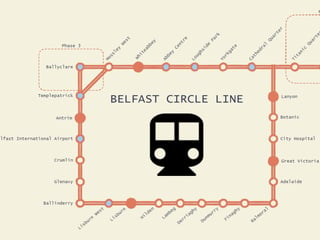
- A new rail connection at Belfast International Airport
- The development of short sections of new railways on congested corridors, including between Belfast – Lisburn – Newry
Here we detail what the proposals hope to achieve for commuters and the environment.
What were the six cross-cutting goals used to develop the review?
- Contributing to Decarbonisation
Decarbonise the rail network, mainly through the overhead electrification of the intercity network, while rural and regional lines could be powered by battery-electric or hydrogen trains.
Procure new hybrid and electric train rolling stock.
- Improving connectivity between the island’s major cities
Increase top speeds to 200km/h (125mph) on the core intercity railway network (Dublin, Belfast, Cork, Limerick, Galway, Waterford, Derry~Londonderry) which, along with an upgrade to track capacity as outlined next, provides for train journeys that are typically faster than the car.
Upgrade much of the single-track cross-country rail network to a double-track railway (and four-track in places), for example between Portarlington and Athlone on the Galway line.
Increase intercity service frequencies to at least hourly.
- Enhancing rural and regional accessibility
Provide more direct services between Ireland’s West and South Coasts, for example between Galway, Limerick and Cork.
Increase service frequency to at least one train every two hours.
Increase regional and rural line speeds to at least 120km/h (75mph).
Reinstate the Western Rail Corridor between Claremorris and Athenry.
Extend the railway into Co Tyrone (from Portadown to Dungannon, Omagh, Strabane), Derry-Londonderry and to Letterkenny in Co Donegal.
Reinstate the South Wexford Railway, connecting to Wexford to Waterford.
Develop the railway to boost connectivity in the North Midlands, from Mullingar to Cavan, Monaghan, Armagh and Portadown.
- Encouraging sustainable mobility
Interventions that can support plans for commuter, inter-urban rail and international connectivity through the cities, noting that many of these interventions fall outside of the scope of the Review and will be advanced by metropolitan area transport plans.
Segregate long-distance and fast services from commuter services through additional track capacity, reducing journey times to/from cities.
- Fostering economic activity
Strengthen rail connectivity to the island’s busiest ports and reduce Track Access Charges for freight.
Develop first-mile-last-mile rail access for Dublin Port.
- Achieving economic and financial feasibility
Improve service quality, with better provision of customer information and catering, ‘clock-face’ timetabling, and better integration with other transport options.
Invest in a rolling programme of accessibility improvements, including step-free access.
How much are the enhancements expected to cost?
If the Review’s recommendations are implemented in full to 2050, the capital cost across the island (Republic of Ireland and Northern Ireland) is estimated to be in the order of €35bn-€37 billion/£29-£31 billion in 2023 prices.
For Ireland, if this investment is split evenly across 25 years, then it amounts to circa €1 billion per annum (in 2023 prices) over and above existing plans. For Northern Ireland, the equivalent total capital annual cost is approximately £0.31 billion.
Additionalcannual costs for operating and maintaining a larger rail network on the island are estimated to be €600 /£500m, which would be partly offset by increased revenue.
Were the views of the public sought?
A public consultation was undertaken for the Review between November 2021 and January 2022 to gather views on the role of rail and priorities for investment. More than 7,000 submissions were received, demonstrating the keen public interest in the development of the rail system. These responses formed a key input into the draft Review Report’s recommendations.
What have the Ministers said?
Minister for Transport, Ireland, Eamon Ryan, stated: “This is not just the first All-Island Strategic Rail Review, it is the most ambitious vision for rail in a century, bringing us forward to a new age of rail. This vision has been made possible by close cooperation between the Departments and agencies north and south.
"Rail not only allows us to carry more people and freight in a more sustainable way, it is the great connector, enabling greater regional accessibility and balanced regional development.
"The Report provides a long-term vision and a series of recommendations for the sustainable development of the rail network on the island. I’d like to see the recommendations actioned as soon as possible, and I’m pleased that work is now well underway, with European Investment Bank assistance, on how we can move forward.”
DfI Minister, John O’Dowd, explained: “The publication of the Final Report of the All-Island Strategic Rail Review, the first of its kind across this island, is historic and I’m pleased we’ve reached this point. The Report provides an evidence-based framework to help guide future investment in our rail network, and will help us meet our climate commitments. The Review has been an excellent example of joint collaboration on cross-border priorities, and this continued partnership will be key to realising its ambitions.
“This publication brings us to a new chapter where we can shape a better future for everyone by decarbonising key services and investing in climate adaptation measures, while at the same time supporting economic productivity through projects, policy and legislation.”