
New pedestrian rail bridge at Jordanstown approved after council decision overturned on appeal
The Planning Appeals Commission (PAC) has overturned a decision by Antrim and Newtownabbey Borough Council’s Planning Committee to refuse a footbridge at Jordanstown railway halt.
The application is for the erection of a glazed pedestrian footbridge, extension of hard-standing area, refurbishment of canopied waiting areas, guard rail installation, landscaping and associated services and works at Jordanstown Road.
The application was refused by the Planning Committee, in February, against a planning officer’s recommendation to grant permission subject to conditions. The duration of the contract is expected to be between 18 to 22 weeks.
There have been 14 letters of objection outlining concerns such as potential loss of privacy, overlooking, impact on character of the area, removal of trees, noise and disturbance.

Translink reported there have been more than 435,000 passengers using Jordanstown halt since the “relocation” of Ulster University and the project was “specifically targeted at improper use of the crossing”.
Threemilewater Alliance Alderman Tom Campbell proposed planning permission be refused on the grounds of scale and massing of design as well as potential disturbance and loss of amenity for local residents, seconded by Glengormley DUP Cllr Alison Bennington.
Permission was refused by the committee following a vote in which seven councillors backed the proposal with four against. However, an appeal by Translink was allowed by the Planning Appeals Commission and full planning permission has been granted subject to conditions.
Commissioner Rachel Taylor said she has “no persuasive evidence to suggest that the footbridge would not be a suitable and safer alternative for passengers and reduce the reliance on the level crossing”.
Five drawings were submitted to the Planning Appeals Commission which provided further detail in relation to the appeal proposal. Three sought to provide clarification on proposed materials to be used on particular sections of the footbridge. The other two drawings comprised a landscape planting plan and an existing tree protection plan.
Main Issues
In her report, the commissioner said: “The main issues in this appeal are whether the development would result in an unacceptable adverse effect on residential amenity and if the scale, form and massing of the proposal are appropriate to the local area.”
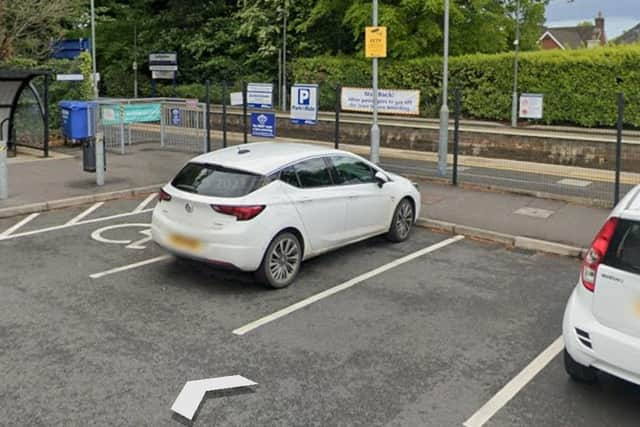
Jordanstown Railway Halt is accessed from Jordanstown Road or from the existing Park & Ride car park off Lynda Avenue. It contains two platforms with associated shelters, seating areas, railings, signage and kiosks.
The commissioner noted: “To the south-east is the residential development of Railway Court, a two-storey apartment scheme with 16 apartments, eight of which have their rear amenity facing the southern platform.
“The halt is bounded to the north-east by the railway crossing point with Jordanstown Road and its associated level crossing barriers which are currently the only access between the platforms.
“The proposal consists of a steel structured pedestrian single span footbridge which is approximately eight metres above ground level and 18.8 metres wide spanning both sides of the railway halt to be finished in metal with inserts of glazing and opaque solid panels with illumination along the handrails.
“The Council acknowledged that the residents of Railway Court currently experience noise and vibration associated with the railway halt from arriving and departing trains and associated noise from commuters waiting on trains or departing from the halt.
“The concern from Council, as well as third parties, is that the proposal will elevate the level at which noise is generated. In their opinion that would have a wider, more direct impact on nearby properties at Railway Court, which are less than 10 metres from the existing platform.
“I am not persuaded that the normal intended use of the bridge for pedestrians crossing it would result in noise levels that would give rise to an unacceptable adverse impact on the amenity of existing or future occupiers of adjoining or nearby properties.
“Whilst it is likely that at night or during periods where background noise levels were lower than normal, footfall on the bridge would be more evident, I am not persuaded that this would be to any unacceptable degree.
“I am not persuaded by the evidence that the proposed footbridge will attract more people than already use the rail halt facility. Notably, third parties indicated a reduced level of footfall given the relocation of Ulster University to central Belfast
“As with the erection of any proposed development, some degree of construction noise is inevitable if it were to proceed.” The commissioner noted the” temporary nature of the works”.
Department for Infrastructure Roads has raised no objections. It was also noted the railway line must remain operational during construction with fabrication off-site to minimise on site works, as well as ongoing liaison with local residents.
The commissioner indicated the external sides of the stairs and landing facing Railway Court would have solid panels and a partial additional height of handrail to 1.8 metres for added privacy
Two existing lighting columns are to be relocated. Illumination within the handrail will help guide pedestrians in the evening. During construction, it was reported levels of illumination would be “kept to a standard that is necessary for safety purposes”.
“No substantive evidence has been submitted to demonstrate that the site currently suffers from or will introduce additional antisocial behaviour or vandalism due to the proposed footbridge,” the commissioner said. CCTV is in operation at present.
“The intended use is a thoroughfare between the two existing platforms as an alternative to waiting at the level crossing, which will also remain operational.
“I find that the scale, massing and design of the proposed footbridge would be appropriate to its site context and that it would not adversely impact on the character of the area.”
The commissioner also reported the Northern Ireland Environment Agency confirmed no objection to the proposed development and was “content there was unlikely to be a significant impact on protected and/or priority species and habitats”.
Michelle Weir, Local Democracy Reporter