
Waiting for Godot heads for Slemish with new Ulster-Scots translation
Samuel Beckett’s most celebrated – and most performed – work, Waiting for Godot, will reinvent itself.
In Waakin fur Ettlin fur Godot (Walking for Waiting for Godot), lovers of the classic play will be able to experience Beckett’s masterpiece performed in the Ulster-Scots language as the Samuel Beckett Biennale presents two new performed readings, either side of the border between Northern Ireland and the Republic of Ireland.
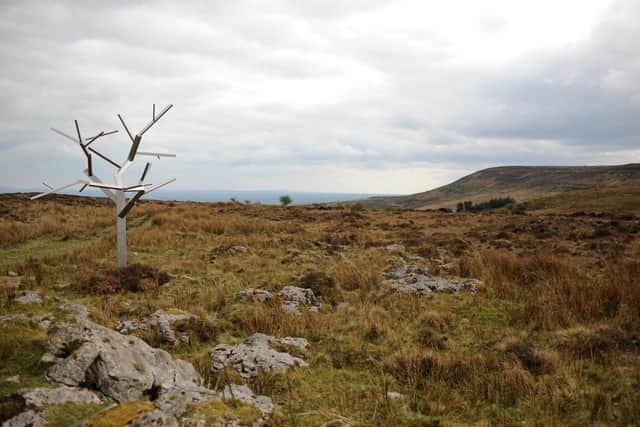

The new Ulster-Scots translation, by Frank Ferguson of Ulster University, will take place on September 26 at Slemish Mountain in Co. Antrim, and on September 27 September in the Wicklow Hills, south of Dublin.
On both days, Waakin fur Ettlin fur Godot begins with the audience catching a bus to a secret location, from which they will walk a gentle kilometre to the spectacular rural scene of the performance, where, fittingly, the actors will already be waiting for them around Antony Gormley’s Tree for Waiting for Godot sculpture.
Seán Doran, director of the Samuel Beckett Biennale, said: “This will be an unmissable new experience for lovers of Waiting for Godot.
"Almost 30 years after the Ulster-Scots language was formally recognised by the Good Friday Agreement alongside the Irish language, we are pleased to be crossing the border with Ettlin fur Godot. In Ulster-Scots, the play becomes an earthier, more visceral and even more moving experience, as two Northern Ireland actors meet two Republic of Ireland actors. Many words are distantly familiar and, when experienced outdoors in the silence of deep countryside, the play gains a new currency.”
Lee Reynolds, Northern Ireland’s Commissioner for the Ulster-Scots and Ulster British tradition, said: “Part of the revival of the Ulster-Scots language must be taking the language to new artistic places and new heights. This new production fulfils both those goals.”
Frank Ferguson, research director for English Language and Literature at Ulster University, said, “The Ulster Scots language is waiting for preservation, like Estragon and Vladimir longing for their Godot, it passes the time in the dialogue of tragicomedy; one-part revelling in comic wordplay and one-part transfixed by the eloquent pathos of loss.”
On September 26, audiences will meet at Gracehill Old School, Ballymena, which Beckett’s mother, May, attended and from which she was expelled for talking to a boy over a fence.
Godot will be performed on the lower slopes of Slemish Mountain, the site of legend, where St Patrick lived after being kidnapped, brought to Ireland and made a slave.
The following day, the Biennale heads to the ‘birthplace’ of Godot, the Wicklow Hills where Beckett often walked with his father. The only Beckett play to be set outdoors, Waiting for Godot was written in France (and in French, as En Attendant Godot) at the end of the Second World War, after Beckett had emigrated, as a final nod from Beckett to Ireland, the place he had chosen to leave behind.
Beckett was a linguist, who wrote much of his work in French and translated it into English (his Godot characters are French, Slav, English and Italian. The new translation follows previous Arts Over Borders productions in French, Yiddish and German and anticipates future global productions in Inuit, Aboriginal Noongar and other First People’s languages.
The Antrim performance takes place close to the coast, just a short ferry ride from Scotland, where many of the words of the new translation are still in use or very familiar. Marking the 250th anniversary of the US Declaration of Independence, three of the signatories of which were Ulster Scots immigrants, the translation chimes with the lead characters' reminiscences about the 1890s, a time when Ulster-Scots was widely spoken in rural north-east Ireland.
It is fair to say that the Becketts have not fared all that well in the part of the North where Godot will be performed; aside from his mother being expelled from Gracehill, Beckett also experienced a short-lived stint as a teacher at Campbell College in Belfast. While there, Beckett responded to the headmaster's: "Don't you realise you are teaching the cream of Ulster, Mr. Beckett" with "Yes, rich and thick, Headmaster".
Now, mother and son will have some new recognition in the area, as Arts Over Borders brings Beckett’s most famous work to the region on its own rural language.
Tickets links, location details and more at www.artsoverborders.com