
Touchline View: The World Cup reminded us what great player development looks like
Touchline View is a weekly column exploring youth football, player development, coaching and sport, written by Damien Hillen. Damien is a UEFA A Licence Coach, former First Team Coach and current Academy Director at Newry City AFC, with extensive experience in coaching and developing young players. He examines how players learn, think, move and grow, while exploring how football and sport can build confidence, discipline, resilience, character and ambition, both on and off the pitch.
The World Cup final should have been a showcase between two of the best teams in international football. Instead, it was a difficult watch because only one side tried to win it.

Spain played with intensity and purpose. They kept attacking, continued making forward runs and eventually got the goal they deserved. Argentina’s performance was really disappointing. They offered no attacking threat and were more interested in surviving the game than trying to win it.
This piece isn’t a tactical analysis of the final. What interested me was Spain’s intensity without the ball and the physical level they were able to maintain not just throughout the game but throughout the entire tournament. They simply suffocated Argentina.

Whenever Spain lost possession, their players reacted immediately. They accelerated towards the ball, closed passing options and worked together to prevent Argentina from settling and quickly regained possession.
This approach has been a feature of Spanish football for years. They react quickly when the ball is lost and stop the other team from playing by applying pressure. What can sometimes be overlooked is the athletic ability required to do this effectively and consistently.
Pressing is more than working hard. It requires players to recognise the right moment to press, move together and understand which spaces need to be closed. Something Spain are extremely well coached in. Pressing also demands repeated accelerations, quick changes of direction, controlled decelerations, tackling and the ability to recover before repeating it again and again.
Spain kept making those demanding movements for the entire game, including extra time. They had the balance to receive the ball under pressure, the strength to protect it and the physical ability to maintain their intensity despite Argentina's increasingly physical approach.
This is one of the biggest lessons young players, parents and coaches can take from the World Cup.
The best players are not only good with the ball. They are quick, strong, balanced and coordinated. Most importantly, they can perform their technical skills at the speed and intensity the game now demands.
A winger may be able to dribble, but can they accelerate away from a defender? A midfielder may see the right pass, but can they stay balanced and in control when challenged? A defender may recognise the danger, but can they turn and recover quickly to deal with it? These are important questions when we talk about player development.
Parents will naturally focus on what their child does with the ball. They notice passing, shooting, dribbling, assists and goals. They are important, but they are only part of the picture.
A technically gifted player will struggle if they are always half a yard behind, regularly knocked off the ball or find it hard to repeat high intensity sprints and decelerations in a game.
As coaches, we often talk about developing the football brain. We want players to recognise space, understand tactics, make good decisions, solve problems and read what is happening around them. However, those decisions are only useful if the body can carry them out.
I have heard retired players, or those approaching the end of their careers, say that their brain still knows where they should be and what they should do next, but their body can no longer get them there quickly enough.
The football brain makes the decisions. The body carries them out. This does not mean young players should spend hours in a gym. Athletic development should always be appropriate for their age, experience and stage of growth.
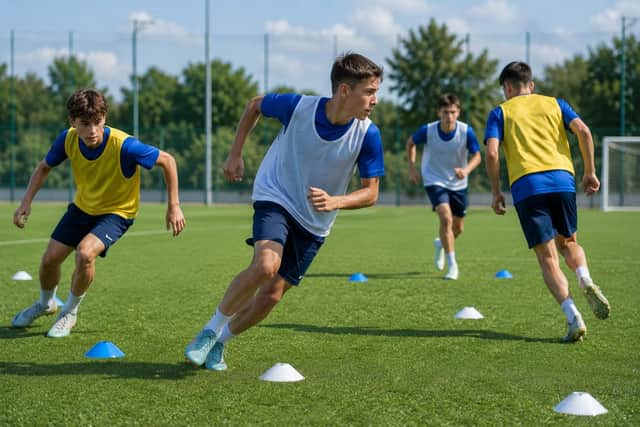
For younger players, it can include sprinting, jumping, landing, balancing and moving in different directions. These activities can be delivered through races, challenges and small sided games that are fun and competitive. As players get older, more structured strength work can gradually be introduced alongside sprint training, mobility, jumping, landing and changing direction which need to be properly coached.
We wouldn’t expect players to improve their passing without repetition and feedback. Sprinting, stopping, jumping and changing direction should be treated in the same way.
One of the common mistakes in youth football is assuming that simply playing more football will develop every physical quality a player needs. Playing football will improve fitness, but it will not automatically teach a young player how to sprint efficiently, decelerate safely or use their body effectively in contact.
The players competing at the World Cup are among the very best in the world. They are an elite few that get to play at this level. Obviously, most children will not become international footballers, and they do not need the pressure of chasing that dream every time they step onto a pitch. We can still learn from what elite players do without expecting children to become elite athletes.
Learning to sprint properly, becoming stronger, improving balance and coordination and moving more efficiently will benefit every young player.
For some, it may help them enjoy the game more because they feel quicker, stronger and more confident. For others, it may give them the opportunity to progress into, senior football or the professional game.
Our role as coaches and parents is not to pressure children into reaching the highest level. It is to give them the strongest possible foundation and allow them to decide how far they want to take the game.
Every young player should have the opportunity to develop both their football brain and the body that allows them to put those decisions into action. Developing both together gives players the strongest possible foundation for their journey in the game, wherever that journey may take them.