
Touchline View: Why the best wide players can keep defenders guessing
Touchline View is a weekly column exploring youth football, player development, coaching and sport, written by Damien Hillen. Damien is a UEFA A Licence Coach, former First Team Coach and current Academy Director at Newry City AFC, with extensive experience in coaching and developing young players. He examines how players learn, think, move and grow, while exploring how football and sport can build confidence, discipline, resilience, character and ambition, both on and off the pitch.
I have noticed from watching and coaching young players that their movement changes as they get older. Most of it is natural movement and, in many cases, they don't even know they are doing it.
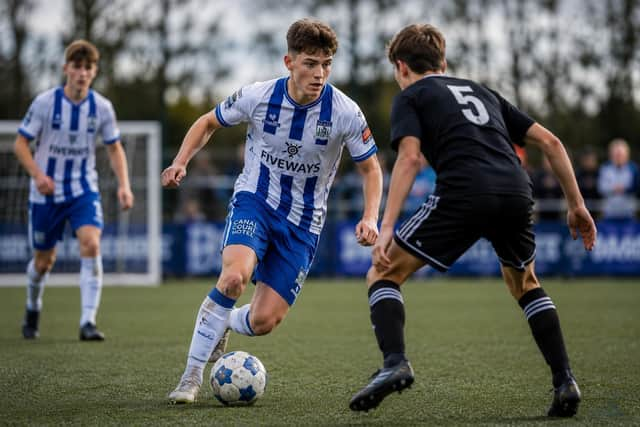

When children first start playing, they run everywhere. They chase the ball and play with very little fear. As they get older and develop technically, their movement becomes more controlled, and they start to understand where they should be on the pitch. That's an important part of their development, but there is a danger that the natural attacking instincts they have are coached out of them.
I was lucky enough to work with a very talented young player who was one of the most naturally attacking and balanced players I've seen. He could glide past defenders and change direction at speed without ever looking off balance. He wasn't afraid to take players on. If he saw an opportunity to attack, he did.

He moved to another club, and I didn't see him play again for about 18 months. When I did, I was surprised by how much his game had changed. That instinct to attack defenders wasn't there. He stayed wide, waited for the ball and, when it arrived, he crossed it. I later found out that was what he had been coached to do, stay wide and, when you get the ball, put it in the box.
There is nothing wrong with staying wide or crossing the ball. Both might be exactly what the game requires. What concerned me was that a naturally talented young player appeared to have stopped looking at the situation he was in and deciding for himself what to do next. So, as coaches, are we helping young players understand the game and make better decisions, or are we making those decisions for them?
You can see another version of this with wide players. When they were younger, they took defenders on and constantly made forward runs. Now, when I watch them, they constantly want to come towards the ball. They drop short, receive it to feet and lay the ball back because they want to get involved in the game. Again, there is nothing wrong with that. We all want players who are comfortable receiving under pressure and confident enough to want the ball. The problem is when that becomes the run they make all the time, which is something that happens a lot as players get older.
As a defender, you want everything in front of you. You want to be able to see the player and the ball, and you don't even have to win it. If you stop the attacker going forward and force them backwards, you've done your job. If the wide player always comes short, your job becomes even easier because you can see the player, see the ball and you know what they are likely to do.
If they mix it up, coming short the first time and then going long and running in behind the next, you now have a different problem. They might run behind you and across into a central area before coming short again. Now, you have decisions to make. Do you follow them or hold your position? Can you afford to get tight knowing they might spin and run behind you? If they run inside, do you go with them or pass them on? That's a very different and much more difficult player to defend against.
For me, being unpredictable doesn't mean having loads of tricks or trying something spectacular every time you get the ball. It's much simpler than that. Vary your runs. And good movement isn't always about getting the ball from a teammate. Sometimes you've done your job by moving a defender and creating an opportunity for somebody else. Coming short can draw the defender with you and create space behind for a centre forward or attacking midfielder to run into.
That's something young players can find difficult to understand. I've seen players make a really good run, not receive the pass and become frustrated, throwing their arms in the air. They make another one and still don't get it, so they stop for a moan. From their perspective, they have made two or three great runs for nothing, while the coach sees a defender being pushed deeper and space opening up elsewhere on the pitch that is leading to chances.
The physical demands on wide players shouldn't be underestimated either. Research shows that wide players are among those completing the greatest amounts of high intensity running, particularly sprints. They are expected to attack, recover defensively and repeat those runs throughout the game, but are they making the right runs?
GPS can tell us how far a player has run and how much high speed running they've completed, but distance doesn't mean the running was effective. A wide player can work incredibly hard for the whole game, but if most of their attacking runs are towards the ball, they are relatively easy to defend against.
Pace obviously helps but knowing when to make the run is just as important. If the player on the ball is under pressure and can't play forward, is there any point in sprinting 20 yards behind the defender? If they have time and can get their head up, the same run can be difficult to defend.
That's the part I think we need to develop in young players. We don't want a wide player who runs in behind every time, any more than we want one who always comes short or has been told to stay wide and cross the ball. We want them looking at the defender, the space and the player on the ball and deciding for themselves what is needed and what they should do next.
The best wide players aren't necessarily the ones who run the most or have the most touches. They're the ones who understand when to come short, when to stay wide, when to run in behind and when their movement can create space for somebody else. They read what is happening in front of them and know the best run to make to keep even the best defenders guessing.