
Touchline View: Youth Football is about more than results
This is the first edition of Damien Hillen’s weekly column focused on youth football and sport in general. Damien is a UEFA A Licence Coach, former First Team Coach at Newry City AFC, current Academy Director at Newry City AFC, and one of the founders of Windmill Stars Youth Academy. He has seen first hand how football and sport can shape young people in terms of confidence, discipline, resilience, attitude, and ambition.


In youth football, I think many adults focus on the wrong things first, without even realising it.
If you ask a child about their game the question is often: ‘Did you win?’ ‘Did you score?’ ‘Where are you in the league?’ Those things have their place, of course they do, but they only tell a very small part of the story.
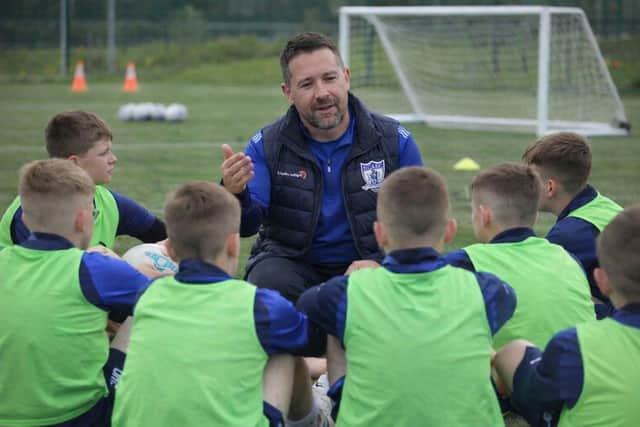
For me, youth football should be about much more than that.
This column will focus mainly on football because that is the sport I know best, but many of the themes behind it apply just as easily to Gaelic games, rugby, tennis, gymnastics, athletics, dance, and other activities that children and young people take part in each week. The sport may change, but many of the lessons do not. Confidence, discipline, resilience, attitude, enjoyment, belonging, dealing with setbacks, learning to work with others, and finding a way to keep going when things are not easy are all part of growing up through sport.
That is one of the reasons I wanted to write this column.
Having spent many years involved in youth development and academy football, one thing I have seen time and again is that children develop at very different speeds. Some stand out early. Some take longer. Some are full of confidence from the start, while others need time, encouragement and the right environment before they begin to show what they can do.
That is why I think adults in the game need to be careful.
Too often in youth football, players are judged far too quickly. The biggest or most physical child at ten could be the best player at 16 but most of the time they are not. The quiet child who lacks confidence today may be the one who thrives later on. Development isn’t a straight line.
In my view, that is one of the biggest mistakes we make in youth sport.
Children are not finished products. They are still growing, still learning, still figuring things out. Some need challenge. Some need reassurance. Some need time. The job of a coach is not simply to organise a session or pick a team. It is to understand the child in front of you and create an environment where they can improve, make mistakes, grow in confidence and keep coming back for more. That, to me, is what good coaching looks like and there are some great coaches in this area doing fantastic work.
Parents have a huge role to play. Children remember how football made them feel. They remember whether they felt under pressure or supported. They remember whether they looked forward to a game or dreaded it. In most cases, that feeling stays with them far longer than any result ever will.
I have lost count of the number of times I have heard adults speak to kids after games: ‘Did you win?’ ‘Did you score?’ Rarely are they asked: ‘Did you enjoy it?’ ‘Did you learn anything?’ ‘Did you work hard?’ In the long run, those questions matter more.
Of course, standards matter. Effort matters. Wanting to improve and win matters. Learning to win well and lose well is part of sport. I am not suggesting results are not important, of course they are. But when youth football becomes too wrapped up in adult expectations, we risk losing sight of what makes it valuable in the first place.
For some young people, football will open real doors. For others, it may never lead beyond local football, which is fine, everyone finds their level. The game still has the power to shape attitude, routine, character, friendships and ambition. That is worth a lot.
These are, of course, just my thoughts and my opinions, shaped by years of coaching and working with young players. I certainly do not claim to have all the answers. There are many very good people across sport doing excellent work in different ways. My hope is simply that some of what I have seen, learned and reflected on over the years might be useful to parents, coaches, and anyone who cares about helping young people develop well.
Over the weeks ahead, this column will look at some of the topics behind youth football and player development.
This will not be a column about scores and match reports. There is already enough of that. It will be about the bigger picture of what youth football can and should be, and why that matters to families, clubs, schools and the wider community.
Because when it is done properly, youth football is about much more than results.