
Portadown FC and Linfield pay tribute to former FA Cup winner Tommy Sloan
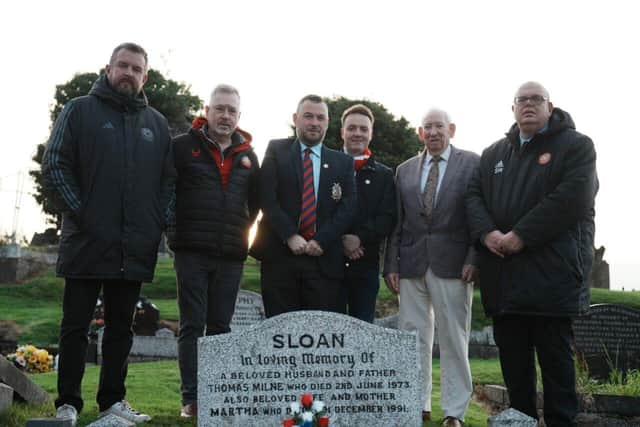
Representatives from both Linfield FC and Portadown FC came together for the official unveiling of the restored grave of FA Cup winner and Northern Ireland international,Tommy Sloan, at Seagoe Cemetery, Portadown, paying tribute to a man who served both clubs with distinction.
The ceremony was organised by the Linfield Graves Project, with founder Michael Cockcroft reflecting on Sloan’s achievements and his lasting legacy within the Linfield family, while Portadown FC historian Trevor Clydesdale spoke warmly about Sloan’s 40 years of dedicated service to the Ports, recounting his immense contribution both on and off the pitch.
Portadown FC Director Jonny Dunlop also laid a wreath on behalf of the club.
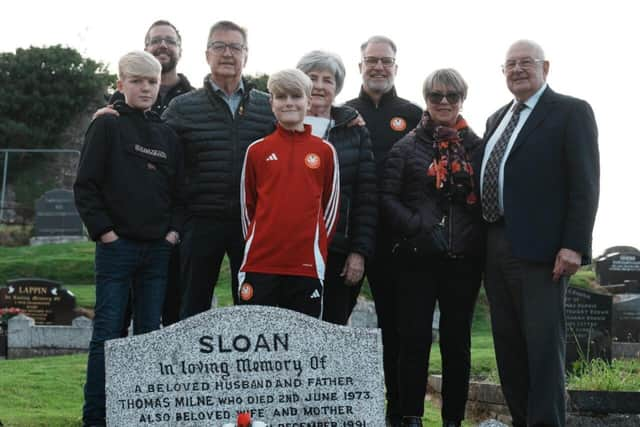
Members of the Sloan family were also present for the occasion, including Tommy’s son, Milne Sloan, his daughter, and grandchildren.

The name Tommy ‘Stickie’ Sloan is synonymous with Portadown FC, having given almost 40 years’ service to the club in various rolls including manager, player, trainer, coach, scout, club secretary and general handyman.
Thomas Milne Sloan was born at 27 Paris Street, Belfast, in the York Street area of the city, a member of a family of four.
At 14 he left St. Mary’s Public Elementary School and went to work as a rivet catcher in Workman and Clark’s North Yard in the Belfast shipyards. In those pre-Great War days, he was playing football for a club named Glenarm, playing in the Ballynafeigh and District League.
When war broke out in 1914 Tommy was determined to do his bit and twice, he tried to sign up by giving a false date of birth, but his widowed mother reclaimed him each time.
In 1916 the dreaded telegram arrived at Ballycarry Street to advise the family that Tommy’s brother John had been killed in action. Tommy again went to the recruiting office and again gave his age as 18. This time he succeeded in getting past the recruiting sergeant and into khaki with the Royal Irish Rifles.
He played in the battalion football team alongside the Manchester City inside-forward Horace Barnes, who, even in those days commanded a transfer fee of £2000.
On one occasion in France, Tommy was the star in the ‘Ack Ack’ team and afterwards had the honour of being presented to the Commander in Chief of the French Forces.
After the war Barnes invited Tommy over to Manchester City but Tommy soon decided to return home where he signed for Crusaders, then playing in the Alliance League. After a row with his boss at the shipyard, Tommy packed in his job and joined the Ulster Special Constabulary, where he was stationed in Castlewellan.
It wasn’t long until he was again coming to the attention of cross-channel teams with Scottish club Third Lanark keen to obtain his signature, and they sent a representative to the RUC station in Castlewellan to enquire about , ‘a fitba player named Sloan’.
He spent three hours extolling the virtues of the game in Scotland, but Tommy’s answer was ‘No’. Third Lanark were not put off by that negative response and after another fine display, his mother told Tommy, ‘If that fellow with the Scottish accent calls again tell him I’m out’. I’ll do no such thing said Tommy I wouldn’t tell a lie I’ll just go out the back door and stand in the entry until he leaves. And that is what he did. It was Cardiff City however that obtained his signature for a fee of £100 and a wage of £5 per week.
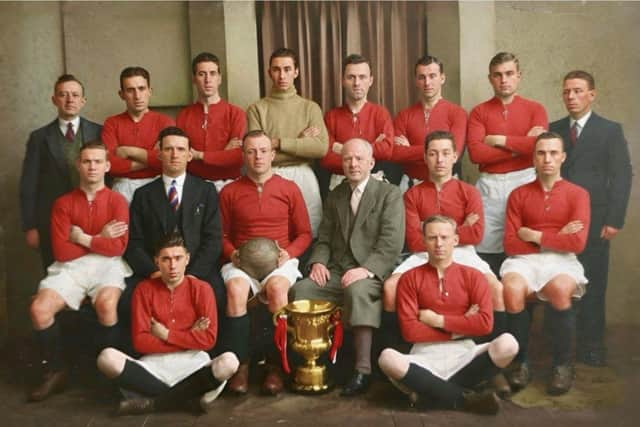
In 1925 he was included in the panel for the FA Cup final against Sheffield United and two years later he played in the famous FA Cup final victory against Arsenal when the famous trophy was taken outside of England for the first time.
His cross-channel career was ended by a cartilage injury, and he return home to sign for Linfield. With The Blues he captained the side to the League and Cup double in his first two season completing a rare treble of winners’ medals in the FA Cup, Welsh Cup and Irish Cup.
International honours also came his way before he left The Blues to take up the reigns as manager at Shamrock Park in December 1932.
Tommy made a scoring start on his Ports debut finding the net against Coleraine on January 28, 1933. Glory soon came his way when he led the club to their first major trophy success, winning Gold Cup in December 1933 with a 1-0 victory against Glentoran.
Results improved and a creditable fourth place league finish was achieved in the1936/37 season. In October 1937 he secured more trophy success lifting the City Cup by defeating Linfield. Later that month he was enticed back to Windsor Park to take over the hotseat.
A year later however he was back at Shamrock Park, but war clouds were again on the horizon and in 1939 he joined up again for Military service as a private in the Royal Army Service Corps. Promotions soon came his way, rising to the rank of Sergeant.
While in France he kept his hand in with football by refereeing a number of games. In June 1941 while on active service he was involved in a serious motor cycle accident which left him deaf in his left ear and eventually led to his discharge from the army.
Tommy returned home to Portadown, working in the Foundry, and in 1942 he took charge of the reserve team in the Intermediate League. After the war he returned to the first team hotseat at Portadown for a third time.
He took up a coaching role in 1950 before a fourth spell as manager in 1952 before reverting to his trainer position in January 1953.
Tommy was never late for work at Portadown, as he lived in 2 Shamrock Villas, later renamed 126 Brownstown Road, beside the gates to Shamrock Park and would regularly be seen hopping over the fence to go to his work. He passed away on
Several suggestions have proffered as to where the name ‘Stickie’ Sloan came from, was it perhaps from his Great War Regiment. The Royal Irish Rifles were known as ‘The Stickies’. Then again the nickname ’Sticky’ is associated with the name Sloan for some obscure reason. Other suggestions were that he always stuck tight to his opponents or that he liked ‘sticky sweets.