
Axing of 'Phone First' system, theatre sessions 'consolidation' and cuts in agency staff costs among saving proposals for Northern Health and Social CareTrust
A reduction in agency staffing costs, theatre sessions “consolidation” and review of “high cost” medical and nursing staffing are among a series of proposals identified as part of a £50m savings plan approved by the Northern Health and Social Care Trust board.
A decrease by £7.5m expenditure on nursing and medical agency staff was proposed in a first phase of cuts and a further £2m has been earmarked in a second phase, according to the Trust Savings Plan 2026/27.
The Northern Trust delivers health and social care services to a population of approximately 480,000, employing around 12,000 staff and has a budget of £1.2bn with a statutory duty to break even financially each year.
The Trust Savings Plan 2026/27 says that a “nurse stabilisation programme” aims to reduce expenditure on nursing and midwifery agency staffing through “improved rosters, increased use of internal staffing solutions, where available, and targeted recruitment”. Medical workforce reform aims to reduce expenditure on medical locum staffing by similar means.


From October, selected theatre sessions currently delivered at Whiteabbey Hospital and Mid-Ulster Hospital, Magherafelt will be transferred to Antrim Area Hospital and Causeway Hospital, Coleraine.
The Trust Savings Plan presented to the Trust board said that theatres at these “peripheral sites do not meet performance targets in terms of their utilisation”.
"The aim is to maximise the utilisation of available theatre capacity, improve productivity and throughput, and reduce the number of theatre lists required to treat the same volume of patients,” the report said.
"By consolidating activity onto higher volume sites such as Antrim, the Trust will seek to improve efficiency, increase patient access to treatment, optimise workforce deployment and resource, and support the delivery of elective care targets within available resources”, the report said.
Other potential savings highlighted include a reduction in repairs, maintenance and equipment costs by £606k, private ambulance costs, £221k and a £285k review of administration staffing.
The Trust’s ‘Phone First’ triage service is to be axed, saving £0.5m and expenditure for addressing winter pressures is to be cut by £606k, almost one quarter.
Staff at the Trust’s hospitals can expect a review of car parking charges which is expected to bring in an additional £120k.
The report said that this will “bring tariffs into line with those applied across other HSC (Health and Social Care) Trusts”.
"The aim is to generate additional recurring income to support financial sustainability while ensuring a consistent and equitable regional approach to car parking charges,” it stated.
The report also noted a proposal to review and increase staff accommodation charges for staff residing on Trust property, noting that “accommodation charges within the Trust have not been uplifted for some time”.
The Trust says that it has “developed a comprehensive savings plan to support delivery of its financial recovery objectives”.
However, it is still planning to spend £2m on an independent assessment “given the scale of the financial challenge and the need to maximise recurring savings opportunities”, it says. This will also involve a review of high-cost staffing to “identify further efficiency opportunities within high-cost workforce areas”.
The report noted that the ‘Phone First’ system which “provides an initial assessment and triage for urgent care and aims to ensure patients are directed to the most appropriate care setting, reducing unnecessary hospital attendances”, will be dropped.
"While the proposal will result in the removal of the current telephone triage and booking model, it is not intended to reduce the availability of urgent or emergency care services or restrict access to treatment,” it stated.
Commenting at the meeting on the savings plan, interim chief executive Suzanne Pullins said: “We will have to keep a very tight control. We are really under pressure for the rest of the financial year.” She stressed that financial stability is “absolutely critical”.
Stephanie Greenwood, trade union Unison’s health convener, said: “We are not satisfied that this financial plan is consulted on properly and has not been shared with staff.
"Staff are in panic mode. They have heard all sorts of rumours. We are not satisfied an equality impact assessment has been done properly.”
She expressed concern that the opposed cuts would “damage public health and negatively affect the workforce”.
Board chair Anne O’Reilly emphasised a duty to break even financially, which she said, has to be the “major driver and consideration” of the Trust board as well as a focus on patient safety.
"As a senior management team, we have been carrying this for months, trying to figure out the best way to go about this with the least impact. It is very sobering where we are. It is not a comfortable decision we have had to make.”
She stated that the Trust “prioritises strong engagement with trade unions and that will continue”.
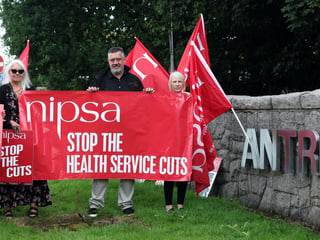
Ian Boersma, higher executive officer, NIPSA, told board members it was “unrealistic” to suggest such a cut in funding can be absorbed with “doing more with less”.
He expressed concern that staff would be expected to “absorb additional duties” and he warned that a reduction in agency workers must not become a reduction in workforce capacity.
"Our members believe there should be no cuts to the health service. Patients and staff should not be expected to pay the price. Cuts dressed up as efficiencies are still cuts.”
The Department of Health says it is facing a funding gap of around £800m and is currently overspending by £2m per day.
It indicated that Trusts in Northern Ireland have been developing savings plans since January.
The Department said this will include a “vacancy control process, reducing temporary staffing (including bank, agency and locum staff) and setting the appropriate number of hospital beds as more care is delivered in the community, closer to people’s homes”.
"Trusts will also standardise care pathways, shorten hospital stays and reorganise services to strengthen and sustain vulnerable services.”
.
,