
Charlotte Riddell: Blue plaque for County Antrim 'queen of ghost stories'
One of the most successful novelists of the Victorian era is to be commemorated with an Ulster History Circle blue plaque in Carrickfergus, where she was born.
The author of over fifty novels and short stories, Charlotte Riddell (1832-1906) probed the moral ambiguity at the heart of the newly-prosperous Victorian middle-class and its obsession with the supernatural.
Readers of that era loved her “sensation” novels, responding to the domestic scandals in the plots, the melodrama and suspense.
However, her early writing life was a constant struggle against poverty and rejection at a time when publishing was a male preserve.
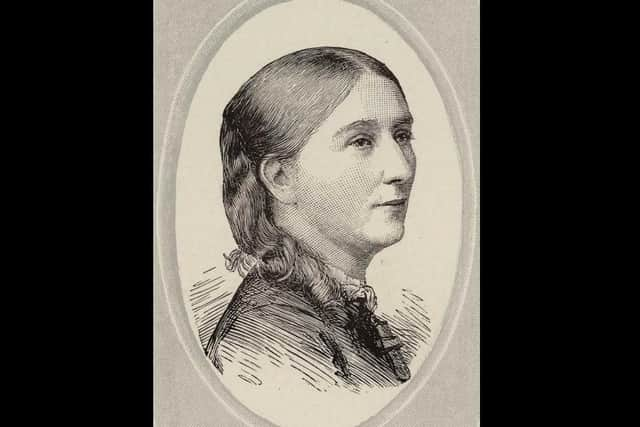

Charlotte Riddell was born Charlotte Cowan at The Barn, Carrickfergus, the youngest daughter of James Cowan, mill-owner and Ellen Kilshaw, who was from Liverpool.
The site of Charlotte’s birthplace later became Carrickfergus Hospital and is close to the Carrick Rangers and Barn United football grounds.
A natural storyteller, Charlotte had written a full-length novel by the time she was fifteen. Her early work included Tales from Boneybefore, a village close to her home. Kingslough was the fictitious name she chose for Carrick.
When her father died, she and her mother were left with very little money. Their home for a few years was a cottage at Craigantlet outside Belfast. Ellen became terminally ill, though neither of them knew it. They moved to London, where Charlotte was determined she would support them both by her writing.
She wrote under various male-sounding pseudonyms, RVM Sparling and FG Trafford among them. It was only after the success of her novel George Geith of Fen Court (1864) that she began to write as Mrs JH Riddell, having married Joseph Hadley Riddell, a civil engineer, some years earlier.
Her husband died in 1880, deep in debt and Riddell once more found herself in near poverty. She went on to co-own and edit the St James Magazine, a well-known Victorian literary publication.
Stories such as The Open Door had the Gothic elements and eerie atmosphere her readers loved. Riddell also explored what enlightened thinkers of the time saw as the dangers to women when a man’s wife was regarded as his property. She was at one with feminist activists who saw a connection between the domestic abuse endured by women and the legal arrangements around marriage.
Charlotte Riddell’s last novel appeared in 1902. Her health declined and she grew steadily poorer, having sold the copyrights to earlier works. Her life was made more comfortable when she became the first writer to get a pension from the Society of Authors.
Charlotte died from breast cancer on September 24, 1906 at Hounslow in Middlesex. She was buried at Heston churchyard.
Chris Spurr, chairman of the Ulster History Circle, says: “Charlotte Riddell, known as ‘the queen of ghost stories’, born at The Barn in Carrickfergus, found fame as a novelist in Victorian London. The Ulster History Circle is delighted to commemorate this once-popular and prolific writer with a blue plaque at the appropriate setting of Carrickfergus Library. The Circle is grateful to the Ulster-Scots Agency for their financial support towards the plaque and to Libraries NI for their kind assistance.”
The plaque to Charlotte Riddell will be unveiled on Tuesday, September 30 at 11.30am at Carrickfergus Library, Joymount.