
Obituary: Fr Peter Kerr was enormously popular with parishioners everywhere by simply being himself in all his humility
He came from a heartland of rural Ireland, Carrickmore, the parish of Termonmaguirc, the townland of Innishatieve. He inherited its cultural lore, the local customs, the ballads, music, GAA intensity, the sense of belonging, sense of history and destiny.
But more than this, as Fr Peter Paul Kerr often said, for him the Faith was the core dynamic of all inheritance, and his life’s guiding light. This factor enshrined a natural kindness, a calmness and focus, gifts as an excellent historian, as a gaelic footballer, as an overall quiet and strong leader that in a sense, he brought his Carrickmore with him wherever he served in the archdiocese of Armagh.
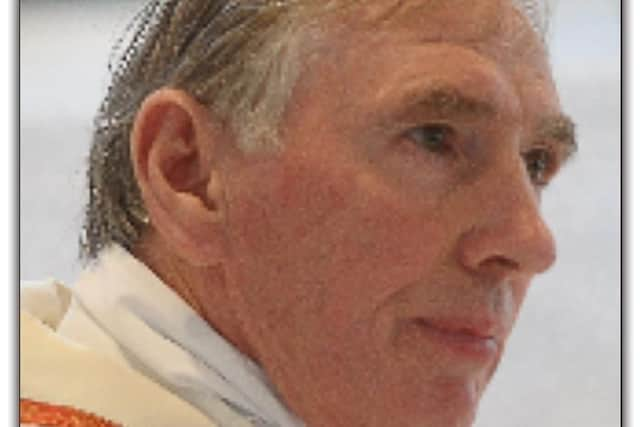

Born in November 1945 to the late James and Annie Kerr, he attended the local Altinagh primary school before going to St Patrick’s Academy in Dungannon, and in 1965 he proceeded to St Patrick’s College, Carlow and was ordained for the Archdiocese of Armagh in 1971 by Cardinal Conway.
His first appointment was as assistant in Darver in Dromiskin until 1973 when he was made curate in Caledon, and two years later became a curate in Armagh Parish, a position he held for eighteen years followed by two years as administrator before being appointed parish priest of, Cill Chluana (Ballymacnb, Granemore and Clady.) During his time there, he restored all three local churches extensively and cleared the debt of all three, not by the usual pulpit demands, but as his parishioner freely admit, by the esteem and affection in which he was held. This included several major bursaries freely given by parishioners. On retirement from Cill Chluana he served several years of pastoral work in his old parish of Armagh before returning to Innishatieve in retirement.
As an historian, he made substantial contributions to the history of his native area in Seanchas Ard Mhacha, notably ‘Land agitation in Termonmagurk, 1885-1886’, ‘Davitt in Carrickmore, National League Meeting ,17 March 1884’, co written with Patrick J Campbell, and ‘Families and Holdings in the townland of.’He also wrote a series of reviews in the same annual publication including ‘Glorious Clonoe ,the story of O Rahillys GFC 1916 –1986’ by Leo Clancy and Michael Keogh, and ‘The Ulster GAA Story, 1884 -1984’ by Con Short.
Fr Peter was an outstanding gaelic footballer achieving four senior Tyrone championship medals with Carrickmore St Colmcille’s, and is particularly renowned for his sensational winning goal in the 1969 final against Coalisland. He also won a Junior Championship with Aghaloo when he was curate in Caledon, but returned to play a part in the victorious three-in-a-row Carrickmore championship team of the late 1970s.
When curate in Armagh city the took over the Harps GAA club as manager in 1989 and led them to their first Armagh senior title in thirty years, regaining the championship in 1991 under his guidance.
For many years he was Cardinal O Fiaich’s unofficial driver taking him to Ulster finals and big Croke Park games- both avid GAA men of boundless football lore, and both historians as the conversations developed.
He could sing and recite if the occasion demanded it. People often spoke of his soft voiced rendering of ‘The Mountins of Pomeroy,’ always delivered with closed-eyes intensity, of the purity and poignancy of the distant uilleann pipes sounding in the Tyrone hills.
Throughout all his pastoral life he was inwardly a contented person, totally confident of the road he had taken and in his abilities to get things done without fuss. Confident in his own judgement he would never rush into making decisions. He was enormously popular with parishioners everywhere by simply being himself in all his humility, honesty and quiet depth. Following a lengthy illness in his retirement he died ‘in perfect peace’ on May 6 past as the immediate members of his family recited the rosary in his room.
Accordingly on Thursday May 8, en route to his former Cill Chluana parish for a special Mass that evening the cortege stopped at the gates of Armagh cathedral where a waiting gathering paid their last respects.
Later at St Patrick’s Chapel, Ballymacnab former parishioners acclaimed their devotion to his memory in an outpouring of affection with local schools and organisations mounting guards of honour and a totally packed chapel full of fond memories of his days among them. Chief concelebrant was Mgr Colum Curry along with P.P. Fr Carville.
At the funeral Mass in St Colmcille’s chapel, Carrickmore, chief concelebrant bishop Michael Router told the overflowing assembly that the Christian symbols of a cross, a bible, chalice, paten and priest’s stole were placed on Fr. Kerr’s coffin as a reminder of his devotion to the Eucharist. He described him as a man of deep conviction and dedication, and revealed that one of the last public masses that deceased celebrated was for a group of pilgrims in the ruin of the old Franciscan Abbey in Armagh, the first Mass offered there for over 500 years since the dissolution of the monasteries by Henry V111.
Fifteen other clergy from the archdiocese, including Fr Peter Mc Anenley PP, as well as former classmates from St Patrick’s Carlow along with some religious order friends joined the bishop in the Mass as family members, parishioners and others in the overflowing church took part in an impressive liturgy.
And so he returned to Carrickmore as the local people acclaimed one of their greatest sons. In a sense, he had made return to where he never left, and in that same sense, the people came to say their farewell to a presence that will ever remain.
Deeply regretted by his sorrowing sisters, brothers in law, sister in law, cousins and wider family circle, Archbishop Eamon, Cardinal Sean, Bishop Michael, the priests of the Archdiocese of Armagh and his many, good friends and neighbours.
He is survived by his sisters, Mary, Teresa, Betty, Brigid and pre-deceased by family members John, James, Micheal, Danny, Lena, Peggy, Eoin, Oliver and Bernadette.