
William Love: Blue Plaque honour to Northern Ireland bandsman whose marching tunes are played across the world
A man who penned some of the most familiar tunes played by marching bands has been commemorated with an Ulster History Circle blue plaque near where he grew up in Derry / Londonderry.
William Love had close links with the Hamilton Flute Band based in the Waterside area of the city and the plaque in his memory was unveiled at the New Gate Arts and Culture Centre, on Kennedy Street.
Mr Love first found widespread fame with a march called ‘Moore Street’, named after the location of their band hall at the time.
As well as marches, he composed and arranged sacred music.
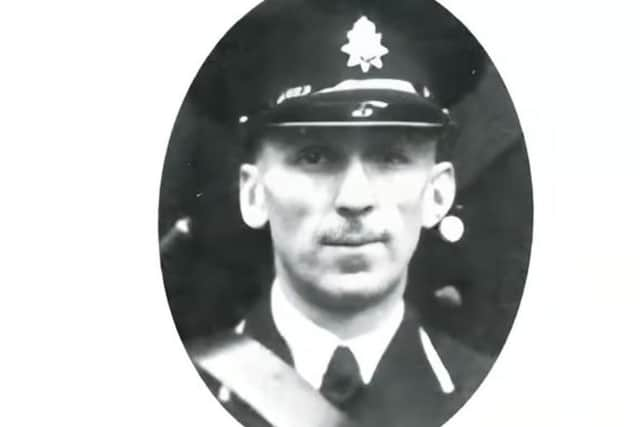

He also engaged with musicians from the nationalist tradition in a way which predated the cross-cultural aspects of today’s marching band scene in the city, those involved in the project said.
William Love was born in the Fountain area on December 23, 1907. His father John was a piccolo player with Hamilton Flute Band, and his son would later become a member and conductor. John joined the Corps of Drums of the Royal Inniskilling Fusiliers and was killed on the last day of the Battle of the Somme in 1916, when his son was only nine.
William went to the Cathedral School and worshipped in St Columb’s Cathedral nearby. He became a baker and went to work in the Abercorn Bakery close to the city walls.
In those early years he played with the Maiden City Flute Band which practised in a shed or stable.
Mr Love is remembered for occasionally taking the baton to conduct the band from the top of a packing case while a horse took its ease in a stall alongside. He was known affectionately as ‘Cowboy’ Love, because of his love for the western films of the time.
He later moved to the Churchill Flute Band and also taught Steelstown, one of a number of bands with which he became associated.
During his time with Hamilton in the post-war years, Mr Love came to be known as a prolific composer and arranger of at least 50 tunes.
After an early start in the bakery he would come home and sit at the kitchen table, trying out pieces on the flute as he composed them.
Others such as ‘Orangefield’ and ‘Charing Cross’ were rehearsed first in his own home and then taken to the Hamilton Band Hall where they’d be given their first full performance.
One march, ‘The Good Companion’, was dedicated to his close friend in music, John Murdie, of Argyle Temperance Flute Band in Belfast.
Mr Love also conducted the Owen Roe O’Neill Band from the Bogside, for whom he arranged music. It was a foretaste in the city of today’s coming together of marching bands from different traditions for whom music is a common denominator.
Mr Love’s tunes went all over the world, to bands in Scotland, Canada and the United States. He also wrote music for broadcast and to mark events like the late Queen’s Coronation in 1953. He passed away in 1966.
According to The Yorkshire Corps of Drums website: ‘His epitaph is worthily written in the crotchets and quavers of his many ear-pleasing compositions. We in the Flute Band world raise our Band caps, our flutes and drumsticks in salute to him.’
Andrew Lynch, co-ordinator of the Londonderry Bands Forum, said: “It’s a great honour for a man from the Fountain who was involved in Bands to be given the recognition we feel he deserves.
"We hope that this Ulster History Circle blue plaque will inspire the next generation of bandsmen and William Love’s music will live on.”
Ulster History Circle chairman Chris Spurr said: “William Love made a most significant contribution to the marching bands repertoire with the number of favourite compositions he wrote.
"Across the decades these continue to delight the countless number of bands and audiences who play and enjoy hearing them.
"Sixty years after his death in March 1966, the Ulster History Circle is pleased to commemorate this renowned composer with a blue plaque in the Fountain where he was born and lived.”
"The Circle is grateful to the Londonderry Bands Forum for their financial support towards the plaque and to their co-ordinator Andrew Lynch for his valued assistance.”