
TOUCHLINE VIEW: The punishment has to matter If we want to stop the abuse
Touchline View is a weekly column exploring youth football, player development, coaching and sport, written by Damien Hillen. Damien is a UEFA A Licence Coach, former First Team Coach and current Academy Director at Newry City AFC, with extensive experience in coaching and developing young players. He examines how players learn, think, move and grow, while exploring how football and sport can build confidence, discipline, resilience, character and ambition, both on and off the pitch.
I was recently asked to contribute to a project looking at abuse of officials in football.
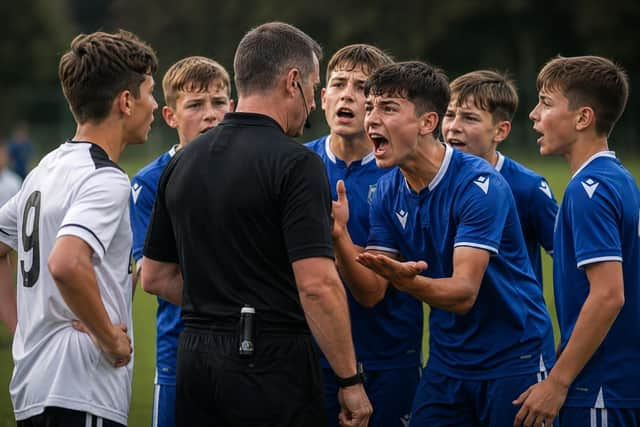

It made me think about some of the things I have witnessed during my time in the game. I've seen managers, players, coaches, referees and assistant referees subjected to verbal abuse, intimidation and personal insults, as well as racial and religious abuse. I've experienced plenty of verbal abuse and intimidation myself.
We talk a lot about abuse of referees, and rightly so, because I think it is becoming one of the biggest threats to grassroots football. We already have a shortage of referees. Games are being spread across Friday, Saturday and Monday so the same officials can referee several different age groups over a weekend.

When one referee decides they've had enough, we aren't necessarily losing an official for one game. We could be losing someone who referees four or five matches every weekend, putting more pressure on a group already struggling to cope.
I know experienced referees who say the abuse doesn't bother them. Some people have the personality and experience to deal with it. Plenty of others don't, and shouldn’t be expected to. Ask yourself this, would you want your son or daughter to do it? Would you want them to spend their weekend being shouted at, called all sorts of names and, in some cases, threatened? I know I wouldn't.
Without referees, we don't have games, so I think football needs to look more seriously at how we change behaviour rather than simply punishing it afterwards.
There will always need to be a distinction between respectfully questioning a decision and aggressively confronting an official. We don't want a game where players can't talk to the referee. What we need to remove is the aggression and abuse that has become normal.
The GAA has taken a brilliant approach. Dissent towards a referee can result in the ball being moved 50 metres up the pitch. On a lot of occasions that puts the opposition much closer to goal and gives them an opportunity to score. A player's decision to argue with the referee can now put his own team in trouble.
There is now evidence that it is working. During the 2025 Allianz Football League there were just 0.4 dissent offences per game. The GAA's Football Review Committee also reported that referees saw a 94 per cent improvement in player behaviour following the changes. It is difficult to ignore figures like that.
Football can learn from it. Rather than simply adding another yellow card offence, I would like to see football trial a sporting consequence for aggressive dissent and abuse. It could be a free kick from a designated area closer to the offending team's penalty area or a corner. The exact sanction would need to be tested, but the principle is straightforward. Abuse the referee and the opposition immediately receives an attacking advantage.
Players and coaches would very quickly understand the consequence because it could cost their team a goal. I also think teammates and coaches would start policing the behaviour themselves. If a player's argument with the referee gives the opposition a dangerous free kick or corner, his teammates aren't going to be happy with him.
We are already starting to use the same principle to deal with time-wasting. Football has introduced the eight-second rule for goalkeepers and is now extending the idea of immediate sanctions to other delays as we saw in the world cup. If a team delays a throw-in, they lose the throw-in. Delay a goal kick and the opposition is awarded a corner. If a player takes too long to leave the pitch being substituted the team has to play with 10 men for at least a minute.
These punishments are different because the opposition gets an immediate advantage. Players have always been prepared to take a yellow card late in a game if they think wasting time will help them get a result. The card is worth it. Give the opposition a corner or possession of the ball instead and the thinking changes.
If an immediate sporting sanction can change the behaviour of players who waste time, why couldn't we use the same principle to change the behaviour of players who abuse referees?
There are also positive measures being trialled in grassroots football. The Captains Only approach makes sense because having several players surrounding a referee is intimidating. Giving the captain responsibility for communication will help. Cooling-off periods give referees an opportunity to stop a situation escalating and put responsibility back on coaches and captains to regain control.
We also need to recognise the influence the professional game has on young players. I've watched eight and nine-year-olds standing over a free kick covering their mouths while they discuss who will hit it, exactly as they have seen players doing on tv. It's funny when you see it, but it shows how closely children copy the behaviour of the professionals.
If they repeatedly see players surrounding referees, screaming at officials and aggressively challenging decisions, we shouldn't be surprised when we see the same behaviour in youth football.
We can continue giving cards, imposing fines and telling people to respect officials, but we've been doing that for years and I'm not sure it’s having an impact. As well as those sanctions, we need to think about what actually changes behaviour.
Football needs referees. We need young people to look at refereeing as something they would enjoy and want to be involved in. I'm not convinced enough of them look at what referees experience every weekend and think, I'd love to give that a go.
If abusing a referee could cost your team on the scoresheet, I think players, coaches and teammates would change their behaviour very quickly, it has already been shown to work in other sports. The most effective punishment might not be the one somebody receives after the game. It could be the one that costs them the game.