
Touchline View: Why every young player needs more 1v1, 2v2 and 3v3 football
Touchline View is a weekly column focused on youth football and sport in general written by Damien Hillen. Damien is a UEFA A Licence Coach, former First Team Coach at Newry City AFC, current Academy Director at Newry City AFC, and one of the founders of the Windmill Stars Youth Academy. He has seen first hand how football and sport can shape young people in terms of confidence, discipline, resilience, attitude, and ambition.
If I asked most 12-year-olds today what formation Manchester City or Liverpool play, there's a good chance they could tell me. Many could probably explain what a false nine is, describe how teams press.

Tactical awareness is a good thing, and computer games have helped with that understanding.
Over time, youth football has become far more organised than it used to be. Players are learning systems and structures at younger ages, while coaches have access to more resources than ever before. But are we developing organised teams before we've developed confident, creative players?

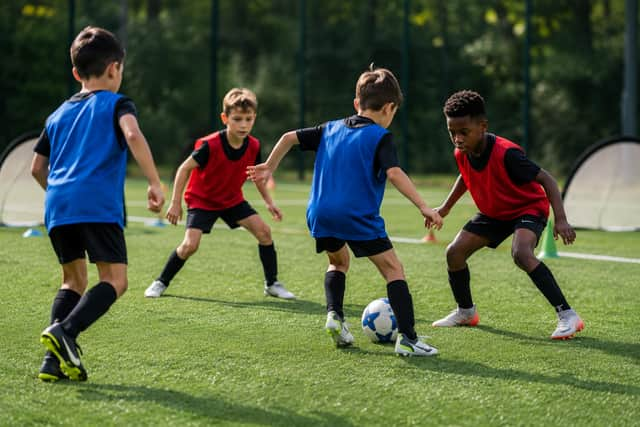
Watch children playing football without adults around and the game looks very different. Every few seconds someone is trying to beat another player. There are 1v1 battles, combinations, tricks, feints, nutmegs and constant competition.
Then watch some organised sessions. Players spend long periods waiting in lines, completing passing patterns or being coached where they should stand or run. They may understand the team shape, but can they deal with the player directly in front of them?
That is why I believe 1v1, 2v2 and 3v3 football should be a regular part of every youth programme.
1v1 – Beat your opponent
I think beating a player is the most difficult thing to do in football. It’s why the greatest players in the world have all been players who were outstanding at 1v1 and taking players on, Pele, Best, Maradona, Ronaldo and Messi. Strip football back and many of the most important moments begin with one player facing another.
Can the winger beat the full-back?
Can the midfielder receive under pressure and turn?
Can the defender stop the striker getting across them?
Regular 1v1 practice develops far more than dribbling. Attackers learn how to change speed, manipulate defenders, protect the ball and recognise when the space has appeared. Defenders learn how to control distance, adjust their body position, delay attacks and recognise the right moment to win the ball.
There is nowhere to hide. Every decision is important and the feedback is immediate.
2v2 – Work with your teammate
As soon as a second player is introduced, football becomes more than an individual battle. Players still have to beat opponents, but now they have to help a teammate do the same.
The player on the ball must decide whether they should dribble, play a one-two or draw a defender before releasing the pass. The supporting player has to decide whether to overlap, underlap, stay away to create space or move closer to support.
Defenders must communicate, decide who presses, who covers and when to switch roles. This is where players begin to understand support, combination play, cover and recovery, not because the coach has stopped the session to explain it, but because they have to do it in the game.
3v3 – Understand the game
Adding a third player changes everything. Players create triangles, overload opponents and add movement to create space for their team mate. They have more passing options but also more decisions to make. They have to scan earlier, support quicker and recognise when to dribble, shield the ball or switch play.
Out of possession, they learn to stay connected, protect central areas and recognise when to press, cover or recover. It is the perfect bridge between individual development and the full game.
Players need permission to take risks
One of the biggest barriers to development is fear of making mistakes.
When coaches become too focused on results, young players quickly learn to choose the safe option. They pass backwards rather than turning to play forward. They release the ball instead of taking someone on because they are worried about losing possession. Players won't become creative if they are afraid to take risks.
Coaches should understand the difference between a positive mistake and careless play. Losing the ball while trying to beat an opponent in the right area can still be a good learning opportunity.
The coach is key
Using 1v1, 2v2 and 3v3 games doesn't mean simply rolling out a ball and letting players get on with it.
The coach's role is so important. Kids come to training full of energy and it’s our job to make sure the session maintains that positivity, if it drops then it’s down to us and the energy we bring to the session.
Small changes to the practice create completely different problems. A narrow pitch encourages direct play and shielding. A wider area means the ball can get wide so there is speed and changes of direction. Four small goals encourage players to scan and attack different spaces. Adding a recovery defender creates transition and forces quicker decisions.
One thing coaches don't need to create is competition. Children are naturally competitive. Our job is to build practices that allow that competitiveness to come out.
More football, less waiting
I've watched too many sessions where players spend more time waiting than playing. Every minute standing in a queue is another minute they aren't touching the ball, making decisions or competing. For teams training only twice a week, every touch matters.
Small-sided tournaments in training are one of the simplest ways to increase intensity. Set up several pitches, play short games and move teams between pitches. Players stay active, touches increase and the intensity looks after itself.
Develop the player before the system
Team organisation is important. Players need to understand shape, space and how to work together.
But systems don't develop players. Players develop systems. A formation can't beat an opponent. A player has to do it. A pressing structure can't make a tackle. A player has to do it. Adding 1v1, 2v2 and 3v3 into training sessions helps to develop footballers who can beat an opponent and solve problems under pressure. They will be able to adapt to almost any system you ask them to play.
Get the player right first and the team follows.