
Touchline View: Why saying less can mean more as a coach
Touchline View is a weekly column focused on youth football and sport in general written by Damien Hillen. Damien is a UEFA A Licence Coach, former First Team Coach at Newry City AFC, current Academy Director at Newry City AFC, and one of the founders of the Windmill Stars Youth Academy. He has seen first hand how football and sport can shape young people in terms of confidence, discipline, resilience, attitude, and ambition.
One of the biggest mistakes I made when I started coaching was thinking I had to give players lots of information. I wanted to help. I wanted to give lots of detail. I wanted kids to understand when to move, how to receive the ball and what to do next.
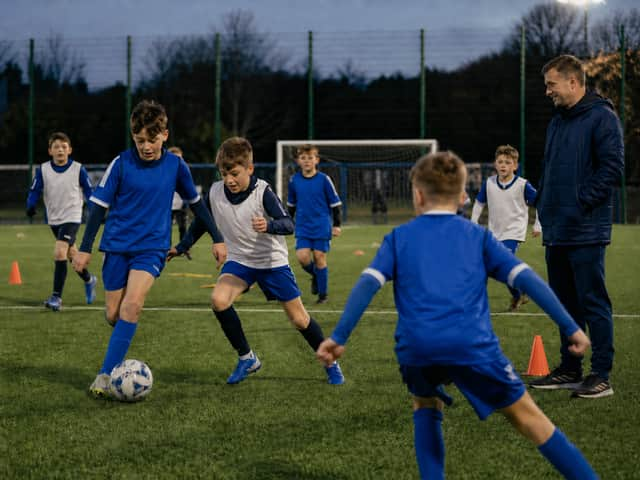

I thought that was what coaching was. Parents were watching so I needed to be seen coaching. I needed to be shouting instructions and pointing at where I wanted them or the ball to go. That is what I thought good coaches did. The intention was right. The method was wrong.
What I understand now is that young players do not need loads of information. They need to be playing, they need contact with the ball, more time in the game and more chances to find solutions and work things out for themselves.

That can be hard. You see something that needs fixed and your instinct is to step in and stop the session. Stop, standstill. You explain the problem, give the answer and send them back out to start again. Sometimes that is needed.
However, quite often, coaches step in too much. I once watched a coach talk to children for 20 minutes of a one hour session. I am sure the intention was good, but that is a third of the session gone before the ball has properly moved. The kids weren’t listening and were bored silly.
As coaches we have very little time with players. We might get 60 minutes twice a week. That time is precious. Every minute the coach is talking, the ball is still. Every minute players are standing in a line waiting for their turn, learning is delayed.
Young players want to play. They want to move. They want the ball. Ask children what they want to do at training and most will tell you the same thing. They want to play matches. They want goals. They want to compete. That is why they enjoy football.
Kids should never be standing in long lines at training. They have come to play. When players start messing about, it is not always a discipline problem. Sometimes it is a session design problem, and they’ve been waiting around for far too long
When I started, I thought good coaching meant giving good information. Now I think good coaching is often about knowing when to speak, when to say nothing and how to design sessions so the game teaches the players.
The first thing coaches need to prioritise is ball rolling time.
How much of the session will involve your players playing, moving, and getting touches of the ball. Footballs should always be used in warmups. If the drill or activity has queues, change it into smaller groups so there is minimal waiting time.
The second thing is to make training look like the game.
If we want players to pass under pressure, they need to train with pressure. If we want them to find space, they need opponents, team mates, direction and decisions to make. If we want them to be brave on the ball, they need training where mistakes are part of learning.
A neat drill can look impressive, but football is not neat. Players have to see pictures on the pitch, deal with pressure, communicate, recover, compete and make decisions quickly.
That does not mean every session has to be a match. It means every part of training should have some connection to the game, irrespective of their age. There is still a place for unopposed work. Young players need to dribble through cones to develop technique, balance and confidence on the ball. The question is how much of the session should be taken up by it.
The third thing is to protect football contact time.
As players get older, strength and conditioning becomes more important. I have seen coaches use their full session to do squats and push ups instead of using the ball. They want the players to be fitter and stronger, I understand that, but we have to be sure we maximise the limited time we have.
If we only have 60 minutes with children, those minutes should be the best 60 minutes of their week. They should leave looking forward to the next session. That is less likely if large parts of the session is spent standing around listening to the coach or doing core work that could be done at home in their own time.
What we should avoid is losing ball rolling time. This is what they come to training for. They get lots of touches and make lots of decisions while they are having fun.
Now, I ask myself this question. Are the kids leaving training having played enough football? Sometimes the answer is no and that happens. No coach gets every session right. The intention, though, should always be to make sure they do.
The best grassroots coaches I know say less, plan well, design good sessions and let the game do a lot of the teaching.
Keep the ball rolling. Keep the players moving. Make sure training looks like the game. Let them compete. Let them score goals. Let them enjoy football and have fun.
Of course, we need to step in and coach. Kids need guidance, help and direction. The skill is knowing when to step in and when to let the game keep going.
In the end, that is where real learning development happens.