
Grave stone erected in memory of a Lurgan war hero who was part of a squad of young Glenavon players who lost their lives due to WW1
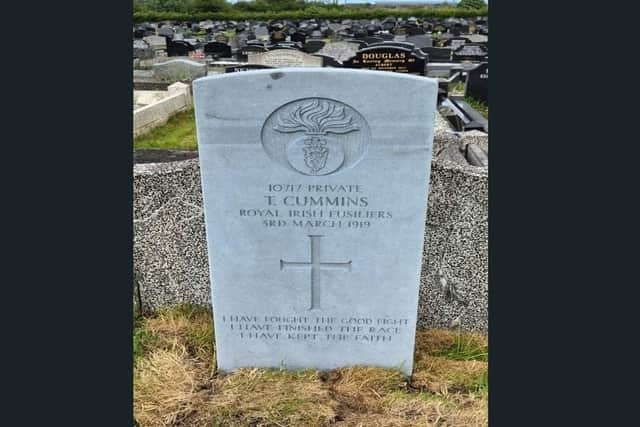
A grave stone has been erected in memory of a young WW1 hero 107 years after his death.
Thomas Cummins was just 26 when he died. He has lain in Lurgan Cemetery of more than a century without a headstone with visitors unaware of his heroism on the battlefields of France.
-

-
Thomas was from Hill St, Lurgan and played football for Glenavon before he joined up.
Born in 1892, the son of Thomas and Mary Ann Cummins, Thomas and several of his brothers worked in the local linen industry.
Football was very important to him and he played for Glenavon Reserves, part of a generation of young Lurgan men who worked hard in the mills and spent their leisure time playing sport for local clubs.
Thomas chose a military career before the war began in 1914. He enlisted in 1910 when he was just 17 into the 3rd (Special Reserve) Battalion of the Princess Victoria's Royal Irish Fusiliers.
He was an active sportsman but sadly in October 1910 he broke his leg playing football. However, this did not stop him from pursuing his military career.
In July 1911 he enlisted at Portadown for regular Army service and joined the 1st Battalion Royal Irish Fusiliers. When war came in August 1914, Thomas was ready.
His battalion formed part of the 10th Infantry Brigade, 4th Division. Thomas sailed to France aboard S.S. Lake Michigan in August 1914 and landed in Boulogne aged 21.
For the next 18 months he would experience the reality of the Western Front. He served with the 1st Battalion in France and Flanders from August 1914 until December 1915 and almost certainly took part in some of the major engagements of that first year, including Le Cateau, the First Battle of the Marne and the First and Second Battles of Ypres.
He was the only one of the Cummins brothers to become what was known as an "Old Contemptible", one of the pre-war soldiers of the British Expeditionary Force who served in France during the opening months of the war.
Back in Lurgan, meanwhile, the consequences of the conflict were becoming increasingly apparent. Glenavon Football Club was losing its players to the Army, and then, one by one, receiving the terrible news from overseas.
Thomas's brother Moses Cummins, also a Glenavon player, was among those lost. Moses served with the 1st Battalion Royal Irish Rifles and was killed in action on 19 July 1915 during fighting near La Croix Marechal in France. He was buried at Y Farm Military Cemetery, Bois-Grenier.
Moses was one of thirteen Glenavon players and officials who lost their lives during the Great War. The list, later read at a Glenavon Act of Remembrance, includes both brothers: Private Samuel Alexander; Lance Corporal Moses Cummins; Private Thomas Cummins; Sergeant Robert Howe; Sergeant Richard Irwin; Private William Kelly; Private John Magill; Rifleman Thomas Mitchell; Sergeant Joseph O'Neill; Rifleman James Tipping; Rifleman John Walker; Rifleman James Weir and Private John Wilson.
Glenavon has described these men as players and supporters who went from the football field to the battlefield, and the club continues to remember the sacrifices they made.
Thomas's own war continued long after the death of his brother. By December 1915, Thomas had become ill and returned to Britain. After recovering, he joined the 3rd (Reserve) Battalion at Buncrana in County Donegal.
Then came another move. On 27 August 1916, he sailed for Salonika as part of the Mediterranean Expeditionary Force, joining the 6th (Service) Battalion of the Royal Irish Fusiliers in the 10th (Irish) Division.
There, far from the trenches of France, he took part in operations against the Bulgarians in the Struma Valley, but years of military service, exposure and hardship were beginning to take their toll.
In March 1917, Thomas contracted tuberculosis. Despite medical treatment, his condition became sufficiently serious that he was evacuated to Britain on 21 July.
He was discharged from the Army on 3 September 1917, having been found medically unfit for further military service. His medical board recorded something that gives a remarkable insight into how he was regarded: "A man of the highest character; served his country well and suffered in health in consequence."
His discharge papers recorded his illness as being the result of "active service, exposure and hardship", and he was awarded the Silver War Badge.
Thomas had survived the battlefields, but he had not escaped the war's consequences. He returned to Lurgan suffering from tuberculosis. Thomas died at his mother's residence in Hill Street on 3 March 1919. Glenavon records him as the thirteenth footballer connected with the club to lose his life as a result of the Great War.
Thomas was buried in Lurgan Cemetery, in plot D332. His military medals, the 1914 Star, British War Medal and Victory Medal were later sent to his next of kin.
Sadly while there are records of his heroic past, there was still no headstone on his grave.
On 13 August 2019, a request was made to the CWGC for Thomas's grave to be marked. It would be almost seven years before that request was fulfilled.
On 26 May 2026, a memorial was erected at Thomas's grave. It bears the emblem of the Royal Irish Fusiliers and records: 10717 PRIVATE T. CUMMINS ROYAL IRISH FUSILIERS 3RD MARCH 1919
Below the cross are three lines: I HAVE FOUGHT THE GOOD FIGHT I HAVE FINISHED THE RACE I HAVE KEPT THE FAITH
Thomas was part of a generation of young men who left the streets and football fields of Lurgan for a war whose scale none of them could have imagined.
Glenavon continues to remember the thirteen players and officials who died in the Great War.
And now Thomas has something else that he did not have for 107 years: a place where his name can be seen.