
John Clifford: Ulster History Circle honours renowned folklorist with the unveiling of blue plaque in Larne
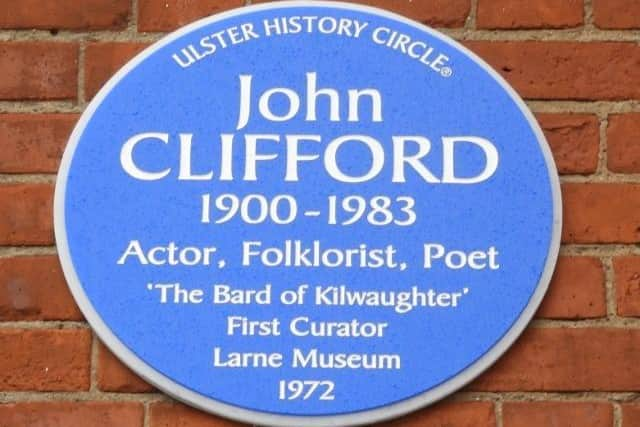
The life and legacy of one of east Antrim’s best known folklorists has been commemorated by the latest Ulster History Society’s blue plaque.
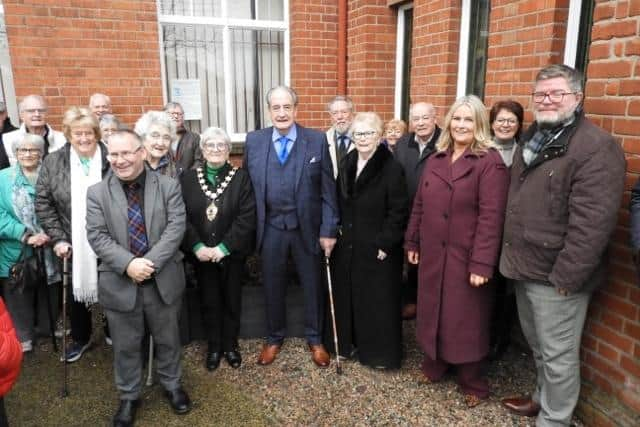
Family and friends of the late John Clifford gathered at Larne Museum and Arts Centre on Friday for the unveiling of the plaque by his son, Raymond Clifford.
A talented playwright, actor, musician and poet, most of all John Clifford had a deep love of his east Antrim roots and culture; the way people in the countryside talked, lived, worked and told stories.
He was ahead of his time in the 1960s, as he was recording all of this information in an effort to preserve the customs and traditions that lay closest to his heart.


Born in Enniskillen in 1900, Mr Clifford moved to east Antrim when he was eight and later was hired out to work on farms in the area when he was a teenager.
He was a friend of actor Richard Hayward, who was also brought up in Larne, and who invited him to London to look for acting work. Mr Clifford realised he needed more education and went to evening classes for five years and joined the civil service.
While educating himself he worked for around 50 hours a week as a wireman in the London Telephone Exchange. He joined the pioneering Unity Theatre and toured with them throughout the UK, presenting drama on social and political issues.
Mr Clifford wrote numerous poems in Ulster-Scots about his adopted homeplace of east Antrim and became renowned as The Bard of Kilwaughter. One of the best known is ‘The Hirin’ Fair’, which he wrote on the south coast of England, sitting on Beachy Head one day in the 1940s when Nazi invasion seemed a real possibility.
As well as being a place for socialising, entertainment and the traditional buying and selling of horses and cattle, a hiring fair in Ulster, the historian Eugene Kielt has written, was “an outdoor employment exchange, where men, women and children made themselves available for service. People went to be hired because of poverty or limited employment at home.”
Mr Clifford didn’t let nostalgia blind him to the opportunities for exploitation:
Frae ivery fairm for miles aroon
The lads an’ lasses mak’ the toon,
Wi’ shiney boots an’ shiney faces,
They seek mair wages an’ fresh places.
The past six months they’ve worked like mad,
For maisters, middlin’, guid or bad:

Some weel-fed, happy and respected,
But ither craiters, starved, neglected.
At the start of the war Mr Clifford had joined the Air Raid Precaution Service and was awarded a medal for his services.
When he came back to Larne after 30 years in London, Mr Clifford became one of the founders of the Larne and District Folklore Society. They brought the tradition back to life, recreating the flavour of an old Hirin’ Fair with local musicians, people dressed in turn-of-the century costume and a horse-trading re- enactment.
Mr Clifford was in the midst of it all, sporting a stage moustache, putting his acting skills to good use and speaking in the local language he loved.
He also helped set up a museum in what became known as the Larne Historical Centre, of which he was the first curator. He worked tirelessly in that post, building up a collection of artefacts for the centre, helped by members of the Folklore Society. It is now the Larne Museum and Arts Centre.
The John Clifford Gallery there is named in his honour, recognising how active he was in preserving artefacts that would otherwise have been lost.
Mr Clifford was one of the most prominent folklorists of his day in Larne and east Antrim. He played fiddle and accordion, sang and wrote and performed in plays.
He also helped revive Mounthill Fair in Larne, one of the oldest horse fairs in Ireland.
Following Mr Clifford’s death on October 8, 1983, Sam Cross, co-founder of Larne and District Folklore Society wrote: “Those of us who were privileged to know him were ever conscious that we were in the presence of a living legend.
"We never ceased to wonder at his boundless energy, his youthful enthusiasm, his marvellous poetic gifts…John had a deep rooted love of his native soil, its people and its language, which 30 years in London left undimmed.”
Mr Clifford’s remarkable story caught the imagination of Comber woman Lolly Spence, who compiled his life’s work into a book.
‘The Life and Collected Works of John Clifford – The Bard of Kilwaughter’ presented an overview of his life, interposed with transcripts of his one-act kitchen plays and his many vernacular poems.
Lolly Spence organised a series of events at Larne Museum and Arts Centre last year for the 40th anniversary of Mr Clifford’s death.
She said: “John Clifford was exceptional- hardworking, talented, civic-minded, with a broad range of interests. He recognised that he was living through changing times so he recorded folklore, language and history to leave us a valuable record. His legacy is of interest to scholars and local folk, to linguists and historians.”
Ulster History Circle chairman Chris Spurr added: “John Clifford recognised it was important to remember and celebrate the speech and the history of the people in east Antrim. The Ulster History Circle is delighted to commemorate this renowned folklorist, actor and poet with a blue plaque on the building where he was the first curator of the Larne Historical Centre.
"The Circle is grateful to the Ulster-Scots Agency for their financial support towards the plaque, and to Mid and East Antrim Borough Council for their kind assistance.”