
Imagine stepping back in time, walking among the remnants of ancient civilisations, grand castles, and serene monastic sites.
From mysterious circles to the dramatic ruins of medieval strongholds, each location tells a unique story and offers a chance to connect with a bygone era.
So, why not lace up your shoes and venture out? These historic ruins are more than just old stones; they are invitations to explore, to wonder, and to truly experience the depth of Northern Ireland's heritage.
Check out our list of places where you can discover a fascinating past.
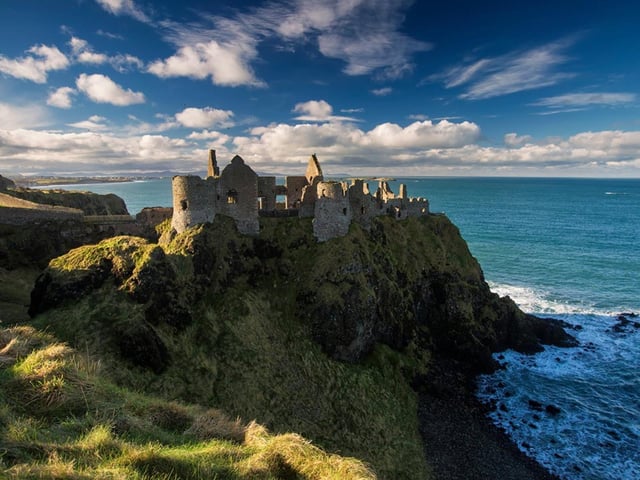
1. Dunluce Castle, Bushmills
Perched dramatically on the coastal cliffs of north Antrim, Dunluce Castle is one of Ireland's most picturesque and romantic ruins. While evidence suggests settlement from the first millennium, the present castle ruins primarily date from the 16th and 17th centuries. Dunluce was once inhabited by the feuding MacQuillan and MacDonnell clans. First built by the MacQuillan family around 1500, it was seized by the ambitious MacDonnell clan in the 1550s under the leadership of the renowned warrior chieftain Sorely Boy MacDonnell. The 17th century saw Dunluce as the seat of the Earls of Antrim, with a small town established nearby in 1608. Visitors can explore the findings of archaeological digs within the cobbled streets and stone merchants’ houses of the long-abandoned Dunluce Town. The castle's dramatic history is complemented by tales of a banshee and the legendary collapse of its kitchens into the sea during a stormy night in 1639. Please note that in times of extreme weather, the site may close for safety reasons. It's advisable to contact the castle directly to confirm opening hours before travelling. Tickets are required for entry and can be purchased at the on-site ticket office. All major credit/debit cards are accepted; online booking is not available. On-site parking is provided. For more information, go to https://discovernorthernireland.com/things-to-do/dunluce-castle-p675011 Photo: Discover Northern Ireland
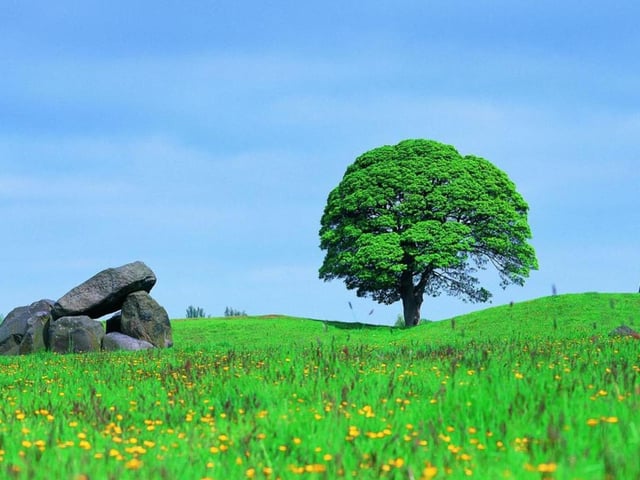
2. Giants Ring, Belfast
Just south of Belfast lies the Giant's Ring, a remarkable 'henge' monument dating back to approximately 2700 BC during the Neolithic period. This massive earthwork circle, roughly 200m in diameter, is one of the finest examples of its kind in Britain and Ireland. At its centre, you'll find the bare frame of what was once a chambered grave, comprised of five upright stones and a large capstone, originally covered by a cairn of stones and earth. The sheer scale of the Giant's Ring is astonishing, covering an area of 2.8 hectares. What we see today is only a portion of a larger cluster of monuments in the area, whose full purpose remains a subject of informed speculation. The site is open daily from 10:00 AM to 9:00 PM, with free entry and on-site parking available. For more information, go to https://discovernorthernireland.com/things-to-do/giants-ring-p674861 Photo: Discover Northern Ireland
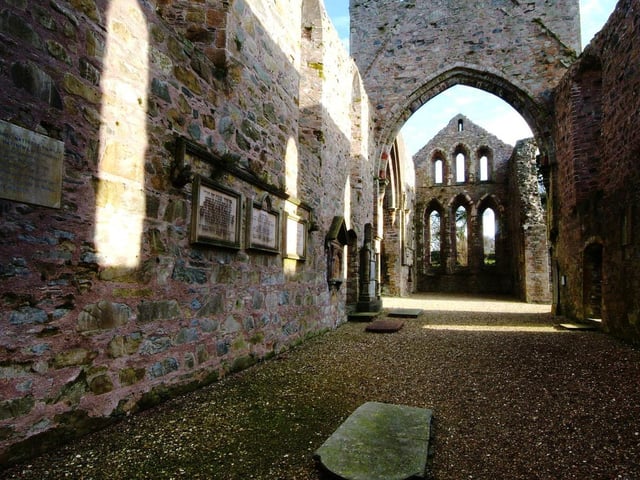
3. Greyabbey Monastery, Greyabbey
Along with Inch Abbey, Greyabbey stands as a prime example of Anglo-Norman Cistercian architecture in Ulster. Situated on the eastern edge of Greyabbey village, it was founded in 1193 by Affreca, wife of John de Courcy, the Anglo-Norman invader of East Ulster. It served as a "daughter house" of Holm Cultram in Cumbria, England. Though poor and decayed in the late Middle Ages, the abbey was dissolved in 1541. However, in the early 17th century, it was granted to Sir Hugh Montgomery, and its nave was refurbished for parish worship until the late 18th century. The abbey was also burnt by Brian O'Neill in 1572. Today, the remains, consisting of the church with its cloister and surrounding buildings to the south, are set within the beautiful parkland of the nearby grand house of Rosemount. On-site parking is available with free entry. For more information, go to https://discovernorthernireland.com/things-to-do/grey-abbey-p675361 Photo: Discover Northern Ireland
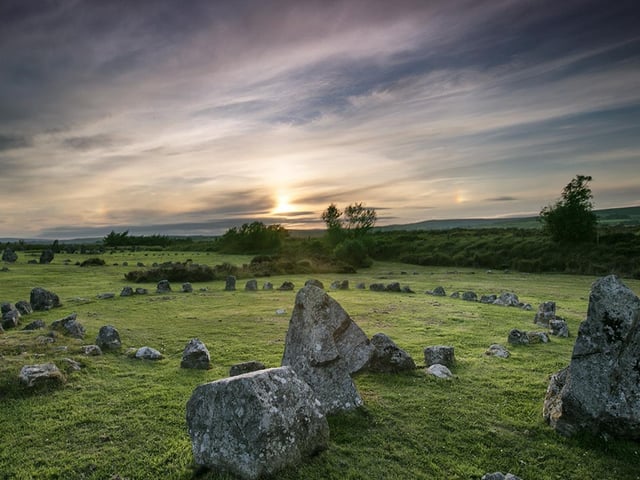
4. Beaghmore Stone Circles, Cookstown
Nestled amidst green grass and heather-clad moorland, the mystical Beaghmore Stone Circles consist of seven circles, ten rows of stones, and twelve cairns, all meticulously arranged. Beaghmore, meaning ‘big place of birch trees’ in Irish (Bheitheach Mhór), was once a dense woodland cleared by Neolithic farmers. The circles and alignments were discovered in the late 1930s during peat cutting, revealing 1,269 stones. The site and surrounding bog indicate occupation from Neolithic times through the Bronze Age. Hearths and deposits of flint tools found here have been carbon-dated to 2900-2600 BC. Several stone rows extend over the tumbled walls of field structures, also dating from the Neolithic period. Visitors report that parking is available with direct access to the site. Both the car park and site access are free. For more information, go to https://discovernorthernireland.com/things-to-do/beaghmore-stone-circles-p675781 Photo: Discover Northern Ireland