
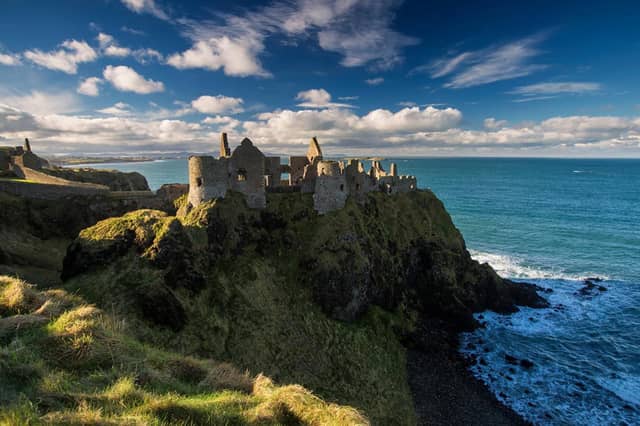

Imagine stepping back in time, walking among the remnants of ancient civilisations, grand castles, and serene monastic sites.
From mysterious circles to the dramatic ruins of medieval strongholds, each location tells a unique story and offers a chance to connect with a bygone era.
So, why not lace up your shoes and venture out? These historic ruins are more than just old stones; they are invitations to explore, to wonder, and to truly experience the depth of Northern Ireland's heritage.
Check out our list of places where you can discover a fascinating past.
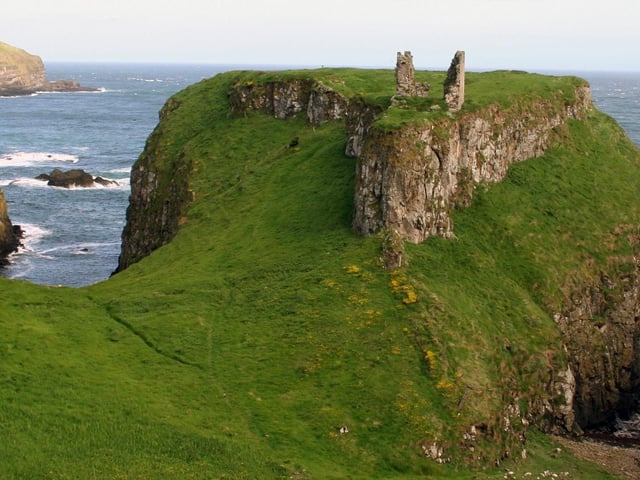
5. Dunseverick Castle, Bushmills
The history of Dunseverick Castle, recorded in the Irish Annals as Dun Sobhairce, is long and complex. It was first fortified by an ancient chieftain named Sobhairce around the 5th century AD, possibly earlier. From about the 7th century AD, it was occupied by the Dál Riada, a tribal group with strong maritime connections between north-east Ireland and western Scotland. It later became a center for the Earls of Ulster (circa 1250–1350 AD) and then a stronghold for the O’Cahan’s and later the MacDonnells from 1560 AD. Legend has it that Saint Patrick himself visited Dunseverick Castle, where he baptized Olcán, a local man who later became an Irish Bishop. The northern part of the site features an oval depression of wet ground, thought to be a holy well and now known as Saint Patrick’s Well. The Irish Annals recount attacks on the site by Vikings around 871 and 924 AD, as well as its destruction by a Scottish army under General Robert Munro in 1642. The final account of the castle’s capture and destruction by Cromwellian troops in the 1650s suggests the site was never refortified or reoccupied afterwards. Due to its proximity to the Giant’s Causeway (a 10-minute drive), Dunseverick Castle is a convenient addition to the Causeway Coastal Drive. Its fascinating history, filled with legends, Ireland’s first kings, St. Patrick, and a fair bit of folklore, offers plenty to discover. There is a mid-sized car park just off the main route (the A2), shortly after Whitepark Bay Beach. From the car park, a short path leads directly to the castle. For more information, go to https://www.nationaltrust.org.uk/visit/northern-ireland/castles-forts/dunseverick-castle Photo: Discover Northern Ireland Discover Northern Ireland
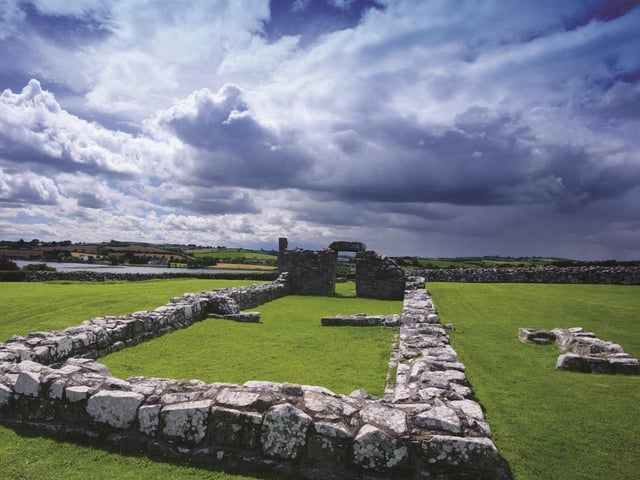
6. Nendrum Monastic Site, Newtownards
Nendrum is believed to have been established by St. Machaoi in the 5th century, with later sources also linking it to St. Patrick. This monastic site comprises three round, dry-stone walled enclosures, nested one within the other. The outer enclosure shows evidence of industrial works. The central enclosure contains the ruin of a church, a sundial, the remains of a round tower, and a graveyard. The middle enclosure holds the remains of huts and workshops. Nendrum is considered the best example of a pre-Norman monastic site in Northern Ireland. Forgotten and overgrown for nearly a millennium, Nendrum's significance was only rediscovered through a series of excavations. These digs uncovered rare evidence of a once-sophisticated community, complete with tidal mills, circular enclosures, and meticulously planned stonework, largely untouched by agricultural damage. Please note: no unaccompanied children under the age of 16 are permitted. On-site parking and free access are available. For more information, go to https://discovernorthernireland.com/things-to-do/nendrum-monastic-site-p675381 Photo: Discover Northern Ireland
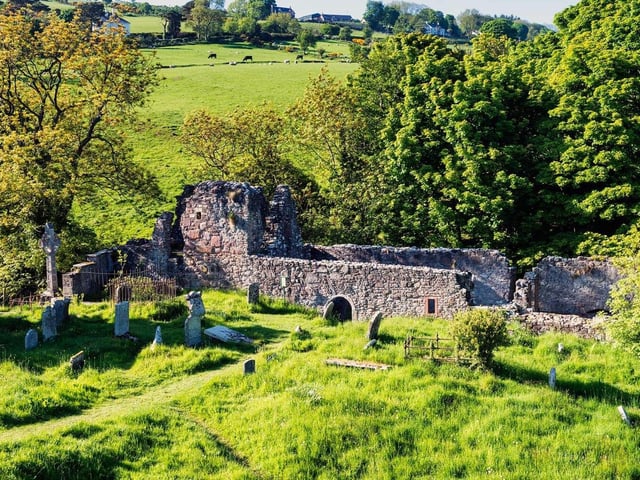
7. Layd Old Church, Cushendall, Co Antrim
Located one mile from Cushendall, Layd Old Church presents the delightful ruins of a 13th-century Franciscan foundation. It served as the chief burial place for the MacDonnells after Bonamargy. The church has been rebuilt at least three times and functioned as a parish church from 1306 until the late 18th century. The graveyard features fine gravestones, including a cross commemorating Doctor James MacDonnell, a pioneer in the use of chloroform for surgical operations. Access is open all year round, offering stunning coastal views. The site is set in a steep-sided valley with uneven ground, so visitors should take care while walking. From the village of Cushendall, take the Shore Road and park in the layby (with access to toilets). Follow the laneway northwards for approximately 200m, then turn right onto the cliff path and follow it along the coast to Layd Church. Entry to this site is free. For more information, go to https://discovernorthernireland.com/things-to-do/layd-old-church-p675021 Photo: Discover Northern Ireland
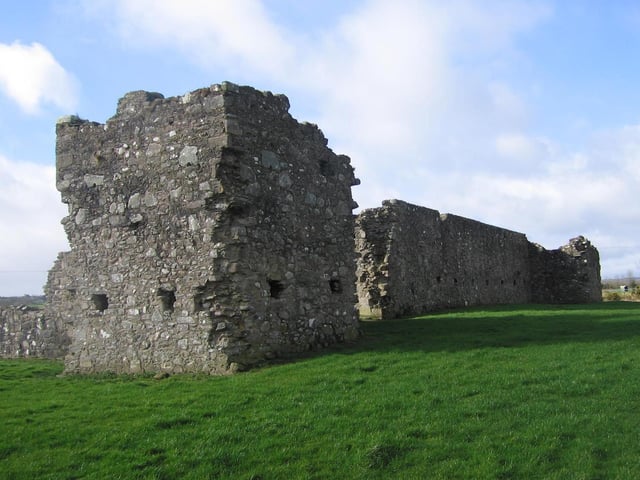
8. Castlederg Castle, Castlederg
Castlederg Castle holds a strategic location on the River Derg, historically commanding a fording point between the O'Neill and O'Donnell Lordships since Medieval times. The visible ruins are the remains of a Plantation-era fortified house and bawn (a defensive wall surrounding a castle). Archaeological excavations, however, revealed the remains of a 15th-century O'Neill tower house that predated the bawn. In 1497, Henry Óg O'Neill, returning from Tír Chonaill, took what was likely then the tower house from the O'Donnells. This rivalry continued until the 16th century when the two powers united to defend Ulster against encroaching Elizabethan armies. The break-up of the Gaelic order in Ulster led to the Plantation scheme. The Castlederg area, within the new barony of Omagh, was granted to Sir John Davies, the English Attorney-General for Ireland. Two castles were constructed on his proportion: Castle Curlews (Kirlish Castle) outside Drumquin and the bulk of what is seen today on the northern bank of the Derg at Castlederg. In 1610, under the Ulster Plantation scheme, the existing Derg Castle was reconstructed into a bawn with three open flankers. Davies also built Kirlish Castle and connected them both with a seven-mile-long straight causeway. Kirlish Castle does not appear to have survived an attack by Sir Phelim O'Neill in late 1641 and has not been occupied since according to historical records. The ruins at Castlederg consist of a rectangular bawn with square flankers at each corner. The riverside flankers (one has been lost to flooding) were open-topped, providing positions for artillery. The flankers on the north side were roofed, forming part of the living quarters. The site is accessible and signposted from Castlederg Main Street, with free entry and further interpretation available on-site. For more information, go to https://discovernorthernireland.com/things-to-do/castlederg-castle-p677361 Photo: Discover Northern Ireland