
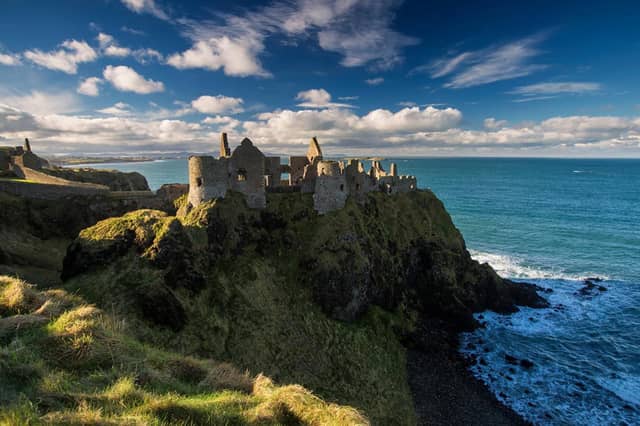

Imagine stepping back in time, walking among the remnants of ancient civilisations, grand castles, and serene monastic sites.
From mysterious circles to the dramatic ruins of medieval strongholds, each location tells a unique story and offers a chance to connect with a bygone era.
So, why not lace up your shoes and venture out? These historic ruins are more than just old stones; they are invitations to explore, to wonder, and to truly experience the depth of Northern Ireland's heritage.
Check out our list of places where you can discover a fascinating past.
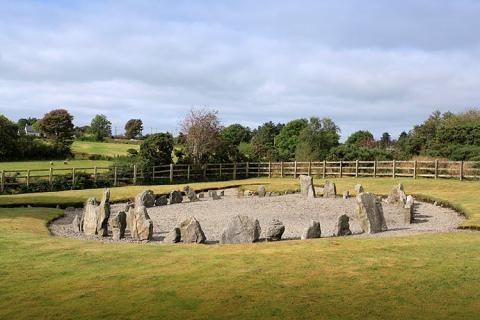
9. Drumskinny Stone Circle, Enniskillen
The Drumskinny Stone Circle site lies in upland bog and was drained following excavations in 1962. It features a circle 12.8m in diameter, composed of 39 stones, and a small round cairn associated with a 7.6m long alignment of 24 stones. The stones are relatively small, and some replaced after the excavation are clearly marked. While much smaller, it shares the same general type as the Beaghmore circles and many others in mid-Ulster. Finds were sparse but included Neolithic material, making it unclear whether the site dates from the Neolithic or the Bronze Age. Other prehistoric stone monuments exist in the bog in this area. Drumskinny (from Irish: Droim Scine meaning “knife ridge”) is the site of a stone circle in the townland of Drumskinny, County Fermanagh, Northern Ireland. With an adjacent cairn and alignment, the stone circle is designated a State Care Historic Monument. This stone circle is part of a complex of five in this immediate locality, dating back to the New Stone Age, around 2250 BC. Its exact purpose is unknown, but it is likely related to religious practices, astronomical observations, and calendar functions. For more information, go to https://www.communities-ni.gov.uk/heritage-sites/drumskinny-stone-circle-cairn-and-alignment Photo: Department for Communities
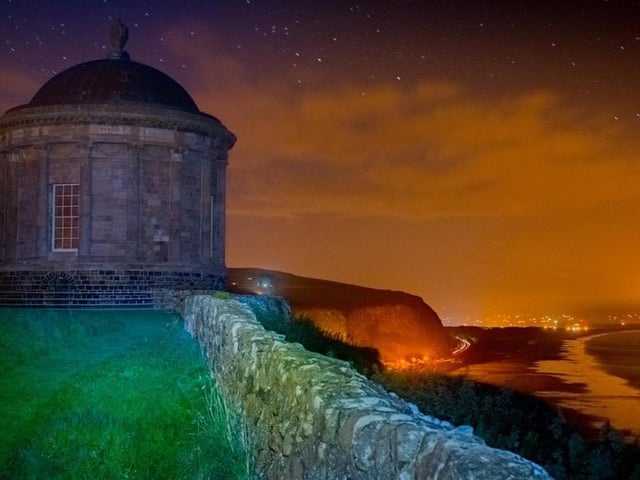
10. Musseden Temple, Castlerock
The term 'demesne' in Ireland refers to the part of an estate typically enclosed by a wall and reserved for the landowner's use. While the Downhill Demesne was once much larger, the iconic Mussenden Temple and the dramatic ruins of Downhill House offer a glimpse into its past and the lives of those who resided there. Downhill House, now in ruins, was once a magnificent building and home to the eccentric Frederick Hervey (1730–1803), known as the Earl Bishop due to his twin titles of Earl of Bristol and Bishop of Derry. Built around 1780 to designs by his architect Michael Shanahan, the house featured a three-story, south-facing front (still visible today) and two long wings extending towards the sea, ending in two immense curving basalt bastions. The Earl Bishop chose this remote spot for his family home because the land was part of his Diocese as the Bishop of Derry. Frederick, married to Elizabeth Davers with whom he had five children, was widely travelled and well-read. He was an expert in flora and fauna and possessed a fine appreciation for art, particularly Greek and Italian. His eccentricities were legendary; it is said he made his clergy participate in a leapfrog race on Downhill beach to determine who would win the best area. He was also rumored to have had many affairs, and before his death in Italy in 1803, he requested his body be shipped back to England in a casket of sherry. Pay and display parking is available at Lion's Gate, where charges apply. The machine only accepts cash (no notes) and requires exact change. The fee is £10 per vehicle for the full day. A coffee shop is located near the site, and dogs are permitted on leads. For more information, go to https://discovernorthernireland.com/things-to-do/mussenden-temple-and-downhill-demesne-p675701 Photo: Discover Northern Ireland
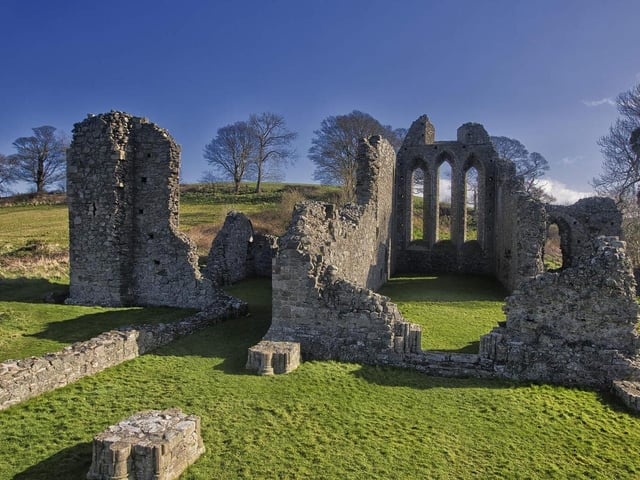
11. Inch Abbey, Downpatrick
Situated on the north bank of the Quoile River, Inch Abbey was founded by John de Courcy in atonement for his destruction of Erenagah Abbey. The existing buildings largely date from the 12th and 13th centuries, though it is believed the church predates that at Grey Abbey, built around 1193. Before the abbey, a pre-Norman church called Inis Cumhscraigh occupied the site, which was plundered by Vikings in 1002. Its large earthworks, clearly visible from the air, still survive in parts. "Inch" signifies an island, and the site has been home to an abbey since the first millennium. When John de Courcy arrived at Downpatrick in 1177 and fought off the Irish, the waters around the site were reputedly red with the spilled blood. Having also destroyed another abbey in the area, Erenagh, he founded the present ruins in 1180 as an act of penance, bringing in monks from Furness. One of these monks, Jocelin, famously wrote The Life and Times of Saint Patrick here. Across the water lies Down Cathedral, where Saint Patrick is buried alongside Saints Columba and Brigid. The site's gently undulating terrain means some wheelchair users may find access challenging away from the path leading from the car park to the ruins. No unaccompanied children under the age of 16 are permitted. On-site parking and free access are available. For more information, go to https://discovernorthernireland.com/things-to-do/inch-abbey-p675371 Photo: Discover Northern Ireland